
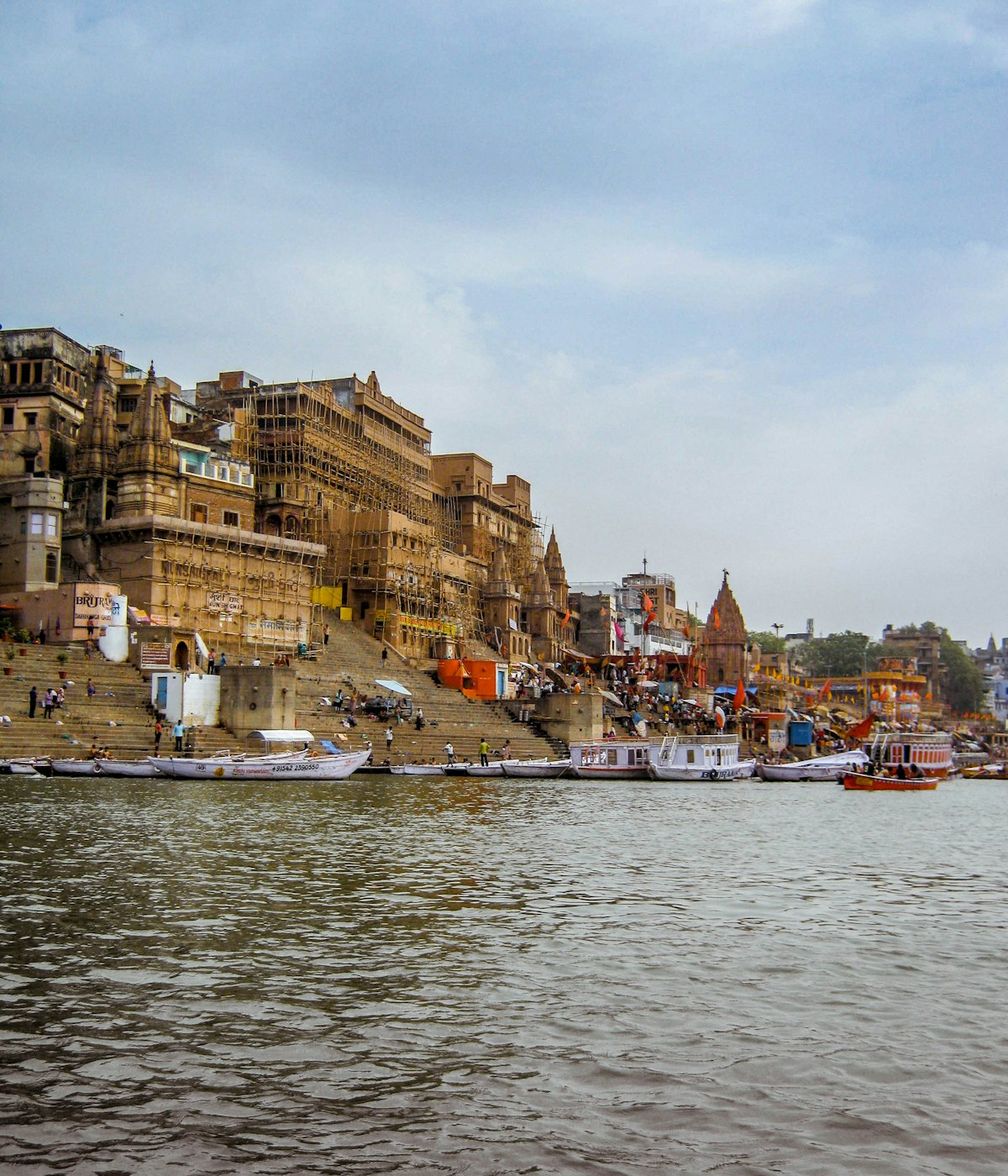
Varanasi: A Spiritual Journey Along the Ganges — Ghats, Dawn Boat Rides & Ganga Aarti | Sanoli India Tours
Sunrise boat ride on the Ganges River, Varanasi — pilgrims at the ghats at dawn Spiritual India · Travel Guide 2026

Varanasi: A Spiritual Journey
Along the Ganges

15 min read Varanasi, Uttar Pradesh Best: Oct – March 2026

No city in India prepares you for Varanasi. You can read about it, watch documentaries, speak to travellers who have been there. None of it is sufficient preparation for the moment when you first walk down a narrow stone lane and emerge at the top of the ghats — the ancient stone steps that descend to the Ganges — and see the river stretching before you at dawn, still and silver, with smoke from cremation fires rising into the sky, flower petals floating on the surface, and pilgrims waist-deep in the holy water, their hands raised in prayer.

Varanasi is one of the oldest continuously inhabited cities on earth — a centre of Hindu pilgrimage, learning, and spiritual practice for over 3,000 years. The Buddha himself gave his first sermon just 10 km away. Mark Twain visited in 1896 and wrote that the city is “older than history, older than tradition, older even than legend.” Nothing about Varanasi has fundamentally changed since then — and that is exactly its power.

“Varanasi does not show you India’s beauty. It shows you India’s depth. And that is an experience no other destination in the country quite matches.”

— Sanoli India Tours Travel Journal

Understanding Varanasi: Why This City Is Like Nowhere Else

Varanasi — also known as Banaras or Kashi — sits on the western bank of the Ganges River in Uttar Pradesh. For Hindus, it is the holiest city in existence: a place where the divine and the earthly intersect, where dying is considered a path to liberation, and where the Ganges is not a river but a goddess.

Hindus believe that dying in Varanasi and having your ashes scattered in the Ganges releases the soul from the cycle of death and rebirth (samsara) and grants moksha — spiritual liberation. This belief draws millions of pilgrims each year, many of whom come specifically to die here, or to bring the ashes of loved ones to the river.

For the traveller, this creates an experience unlike anywhere else on earth — a city where life and death are completely visible, where grief and celebration exist side by side, and where the intensity of spiritual life is simply overwhelming. Varanasi does not ask for your religious beliefs. It asks only for your presence, your respect, and your willingness to be moved by something much larger and older than yourself.

🕌 Also Known As

Banaras, Kashi — City of Light; one of the 12 Jyotirlinga sites

📍 Location

Western bank of the Ganges, Uttar Pradesh, North India

🏛️ History

Over 3,000 years as a centre of Hindu pilgrimage and learning

🕍 Ghats

88 sacred stone staircases descending to the Ganges River

The Ghats of Varanasi: 88 Steps to the Sacred River

The ghats are the defining architecture of Varanasi — 88 stone staircases descending from the city to the river, stretching for several kilometres along the western bank of the Ganges. Each ghat has its own character, history, and ritual purpose. Walking the full length of the ghats is the single most important thing you can do in Varanasi — and it takes at minimum three to four hours to do properly.

Colourful wooden boats moored at the Varanasi ghats with the vibrant city rising behind them

The ghats of Varanasi — colourful wooden boats line the Ganges, the city rising in layers of colour and devotion behind them.

Dashashwamedh Ghat

The main ghat and the most visited — the setting for the magnificent Ganga Aarti ceremony (see below). Its stone steps are ancient and worn smooth by millions of bare feet. This is the heartbeat of Varanasi’s public spiritual life.

Manikarnika Ghat

The principal cremation ghat, where funeral pyres burn continuously — 24 hours a day, 365 days a year. This is where the dead are brought from across India and beyond to be cremated at the holiest spot in Hinduism. The workers — members of the Dom community — have managed the cremation fires here for generations. Photography is absolutely prohibited at Manikarnika Ghat. This is someone’s grief and someone’s sacred moment of departure from this life. Observe quietly, respectfully, and from a distance.

Assi Ghat

At the southern end of the ghat walk, this is the most peaceful and most popular with travellers. It is the social hub of Varanasi — morning yoga classes on the steps, chai stalls, cultural performances in the evening, and conversation with sadhus (holy men) and students from the nearby Banaras Hindu University.

Other Notable Ghats

Scindia Ghat is notable for a stone temple that partially submerged into the river centuries ago and remains half-underwater — one of Varanasi’s most extraordinary and most photographed images. Tulsi Ghat is associated with the poet-saint Tulsidas, author of the Ramcharitmanas. Harishchandra Ghat is the second cremation ghat — smaller than Manikarnika but equally sacred.

The Dawn Boat Ride: Varanasi’s Most Essential Experience

If you do only one thing in Varanasi, make it a dawn boat ride on the Ganges.

Set your alarm for 5 AM. In the darkness, walk down to one of the main ghats and hire a wooden rowing boat. As the boatman rows slowly along the river, the city rises above you in layers of stone and ancient architecture. The sky begins to lighten from black to deep blue to violet to gold.

Dawn boat ride on the Ganges River, Varanasi — tourists in a wooden rowing boat at sunrise with the ghats in the background The Ganges at dawn — a moment that no photograph fully captures

What you see from the river at dawn is the full sweep of Varanasi’s spiritual life simultaneously: pilgrims descend the ghats and enter the water, their lips moving in prayer, their hands raised to the rising sun. Priests perform morning puja at small shrines. Flowers float past on the current — offerings placed in the river the night before. The smoke from Manikarnika Ghat rises above the city. Bells ring from unseen temples. The entire scene is bathed in the specific quality of Ganges sunrise light — golden, hazy, and somehow both ancient and immediate — that exists nowhere else in quite the same way.

🛶 Dawn Boat Ride — Practical Tips
  • Hire a boat at Assi Ghat or Dashashwamedh Ghat — negotiate the rate before boarding (₹300–500 for a shared boat; ₹700–1,000 for a private boat for two)
  • Your hotel can arrange a reliable boatman in advance — strongly recommended for the best experience
  • Bring a light jacket — the Ganges at dawn in winter (Nov–Feb) is cool and misty
  • A 1.5 to 2-hour ride is ideal — long enough to watch the full sunrise sequence and drift past all the major ghats

The Ganga Aarti Ceremony: Fire, Devotion & the Divine

Every evening at sunset — and every morning at sunrise — the Ganga Aarti ceremony takes place at Dashashwamedh Ghat. It is one of the most powerful rituals you will ever witness.

Ganga Aarti ceremony at Dashashwamedh Ghat Varanasi — priests holding multi-tiered fire lamps in synchronised devotion at night

Ganga Aarti at Dashashwamedh Ghat — priests rotate multi-tiered fire lamps in synchronised devotion as Sanskrit hymns fill the night air.

Six to seven Hindu priests, dressed in identical saffron and gold silk robes, take positions on the ghat steps as darkness falls. Enormous brass lamps are lit — multi-tiered fire structures that throw warm light across the steps, the water, and the faces of hundreds of gathered pilgrims and visitors. The priests move in synchronised, choreographed devotion — rotating the fire lamps in large circular motions, blowing conch shells, ringing bells, and chanting Sanskrit hymns in voices amplified across the river.

The ceremony lasts approximately 45 minutes. As it proceeds, flower boats carrying oil lamps are released onto the river by pilgrims. The combination of the fire, the chanting, the flower boats floating on dark water, the crowd of devoted pilgrims — and the knowledge that this identical ceremony has taken place on this same spot every single evening for thousands of years — creates an experience of extraordinary emotional power.

“Many visitors, regardless of their personal beliefs, describe the Ganga Aarti as one of the most moving experiences of their lives.”

🔥 Ganga Aarti — Practical Tips
  • Arrive at Dashashwamedh Ghat at least 30–45 minutes before sunset to secure a good viewing position
  • The best elevated view is from a boat on the river — your boatman can position you directly in front of the ceremony
  • The evening Aarti is the larger and more elaborate ceremony; the morning Aarti is smaller but more intimate
  • Dress modestly — covered shoulders and knees are appropriate for the sacred ghat area

Exploring Varanasi’s Old City

The old city — the narrow lanes between the main roads and the ghats — is one of the most intensely alive urban environments in India. There are no cars here (lanes are too narrow), only bicycles, motorcycles, sacred cows, sadhus, pilgrims, students, and an extraordinary density of temples, shrines, chai shops, and silk weavers working in tiny ground-floor studios.

Kashi Vishwanath Temple (The Golden Temple)

Also known as the Golden Temple — its shikhara (spire) is plated with gold donated by Maharaja Ranjit Singh — this is one of the twelve Jyotirlingas, the most sacred Shiva shrines in Hinduism. Non-Hindus cannot enter the inner sanctum, but the temple’s surroundings give a sense of its extraordinary religious significance. This is the spiritual core of Kashi. If you’re planning a Jyotirlinga Yatra, Varanasi is an unmissable stop.

The Galis (Lanes) of the Old City

There are over 2,000 temples in Varanasi’s old city. Getting deliberately lost in the gali network between the ghats and Vishwanath Temple is one of the great walking experiences in India. You will discover shrines, sweet shops, music teachers, silk weavers, and conversations with locals that no guidebook anticipates.

Varanasi Silk

Varanasi is the most celebrated silk weaving centre in India. Banarasi silk sarees — woven with gold and silver thread on handlooms — are among the most beautiful textiles produced anywhere in the world. Visit a weaver’s workshop in the Muslim weaving communities near Madanpura to see the extraordinary skill involved in creating a single saree that can take weeks to produce.

Sarnath: Where the Buddha Began

Just 10 km from the centre of Varanasi, Sarnath is one of the four holiest sites in Buddhism — the place where the Buddha gave his very first sermon after attaining enlightenment at Bodh Gaya. For travellers on a Buddhist Pilgrimage Circuit, this is a profoundly moving destination.

Dhamek Stupa at Sarnath near Varanasi — Buddhist monks in saffron robes circumambulate the ancient stupa at the site of Buddha's first sermon

The Dhamek Stupa at Sarnath — built in 500 CE, this marks the exact spot where the Buddha gave his first teaching. Buddhist monks from across Asia come here in pilgrimage.

The Dhamek Stupa is a massive cylindrical structure of brick and stone built in 500 CE, marking the exact spot where the Buddha’s first teaching took place. Surrounding it, the ruins of the ancient monastery complex where the Buddha and his early disciples lived are quiet and contemplative — extraordinary considering that Buddhist pilgrims from across Japan, Sri Lanka, Thailand, and Tibet come here continuously.

The Sarnath Museum contains the original Lion Capital of Ashoka — the 3rd-century BCE stone sculpture that was adopted as India’s national emblem after independence. The quality and condition of this 2,300-year-old sculpture is remarkable.

🏛️ Sarnath — Practical Tips
  • A 30-minute auto-rickshaw ride from Varanasi’s old city (approximately ₹200–300 return)
  • Morning visits are most peaceful — arrive before 9 AM to beat the crowds
  • Allow 2–3 hours for the site and museum combined
  • The site is open from 6 AM to 5:30 PM; museum closes Monday

Best Time to Visit Varanasi

October to March is the ideal window, with cool, clear weather (12–28°C) making exploration far more comfortable than the summer heat (up to 45°C) or the intense monsoon humidity. Varanasi is a year-round destination — the spiritual calendar never pauses — but winter is when the city truly comes alive for visitors.

🪔 Dev Deepawali

15 days after Diwali (Nov). Every ghat illuminated with thousands of oil lamps — one of the most beautiful sights in India.

🕉️ Maha Shivaratri

February/March. Hundreds of thousands of pilgrims; all-night ceremonies at Kashi Vishwanath Temple.

🌸 Oct – March

Peak season. Cool, clear skies, the Ganges at its most beautiful for boat rides and photography.

🌧️ Avoid May – Aug

Extreme heat and monsoon humidity make outdoor exploration very challenging.

How Many Days Do You Need?

Planning a trip that includes Varanasi? Our Khajuraho and Varanasi Spiritual Package pairs perfectly with the city’s ancient temples and mystical atmosphere. Here’s how to structure your time:

📅 Varanasi Itinerary Options
  • 2 Days (minimum): Dawn boat ride, morning ghat walk, evening Ganga Aarti, Sarnath, old city exploration
  • 3 Days (recommended): All of the above, plus silk weaving workshops, classical music recital, walking the full ghat length at different hours
  • 4–5 Days (for the deeply curious): Cooking class in a Brahmin household, deeper Sarnath exploration, Ramnagar Fort across the river, unhurried wandering that reveals Varanasi’s most profound layers

Practical Travel Tips for Varanasi

✈️ Getting There
  • Varanasi has an international airport (Lal Bahadur Shastri Airport) with connections to Delhi, Mumbai, and Kolkata
  • It is also a major railway junction — overnight trains from Delhi (12–13 hrs), Agra, and Jaipur are popular and comfortable in AC sleeper class
💡 Essential Tips
  • Hire a local guide — Varanasi’s complexity is enormously enriched by a knowledgeable guide. The context a local provides transforms the experience from bewildering to illuminating
  • Dress respectfully — covered shoulders and knees throughout. Remove shoes before entering temples
  • Photography sensitivity — always ask before photographing individuals. Never photograph at cremation ghats — this is basic human respect, not just etiquette
  • Avoid touts — engage guides arranged by your hotel rather than those who approach you on the steps
  • Food and water — eat at established restaurants. Drink only bottled or filtered water. Varanasi’s vegetarian food scene is exceptional; the sweet shops (mithai) are legendary

Frequently Asked Questions

Is Varanasi safe for tourists?

Yes. Varanasi is a well-established tourist destination with good infrastructure for visitors. The usual precautions apply: use recommended guides, book transport through your hotel, and be appropriately aware in crowded ghat areas.

Is it appropriate to visit the cremation ghats?

Yes, visitors may observe from a respectful distance. Photography is strictly prohibited. Do not touch anything, do not approach grieving families, and do not stare. The purpose of visiting is to observe — not as entertainment, but as a genuine encounter with how another culture approaches death and liberation.

Do I need to be Hindu to visit Varanasi?

No. Varanasi welcomes visitors of all backgrounds and beliefs. The city’s spiritual intensity is available to everyone who approaches it with respect and openness.

What is the best way to experience the Ganga Aarti?

A boat on the river gives the best perspective — you are directly in front of the ceremony with an unobstructed view. Alternatively, arriving early to secure steps near the front of Dashashwamedh Ghat gives an equally powerful, more participatory experience on the ground.

Can I combine Varanasi with other destinations?

Absolutely. Varanasi pairs beautifully with Khajuraho (temples and erotic sculptures), the Golden Triangle, or a Buddhist Pilgrimage Circuit through Bodh Gaya and Sarnath. Our team at Sanoli India Tours can craft a customised itinerary around your interests and travel dates.

Cultural Travel Varanasi Travel Guide Ganga Aarti Varanasi Ghats Spiritual India Sarnath Buddha Ganges River India 2026 Varanasi Packages
✦ ✦ ✦

Continue Exploring India

🏰 Heritage Tour Golden Triangle with Temples

Delhi, Agra & Jaipur — India’s most iconic travel circuit, perfected by Sanoli India Tours.

☸️ Pilgrimage Circuit Buddhist Pilgrimage Circuit

Bodh Gaya, Sarnath, Kushinagar — trace the sacred footsteps of the Buddha across northern India.

🏜️ Rajasthan Heritage Rajasthan Heritage & Temples

Forts, palaces, and temples of the Pink City and beyond — the royal grandeur of Rajputana awaits.

Ready to Experience Varanasi?

Let our expert team craft your perfect spiritual journey to the banks of the Ganges. Trusted since 1991.

Customise My Trip Browse All Packages
33