{
"@context":"https://schema.org",
"@type":"FAQPage",
"mainEntity":[
{"@type":"Question","name":"What is the best time to visit Meghalaya for caves and waterfalls?","acceptedAnswer":{"@type":"Answer","text":"October to April is the most comfortable window for caves, viewpoints and road travel. Waterfalls remain strong after the monsoon, while cave visits are easier in drier months."}},
{"@type":"Question","name":"Is this package suitable for families and first-time visitors?","acceptedAnswer":{"@type":"Answer","text":"Yes. The route is planned as a comfortable private journey with scenic drives, short walks where possible and flexible pacing for families, couples and senior travellers."}},
{"@type":"Question","name":"Do I need a guide for the caves and waterfalls?","acceptedAnswer":{"@type":"Answer","text":"A guide is strongly recommended for the deeper cave experiences and for routes where local knowledge improves safety, timing and interpretation. Sanoli can arrange this on request."}},
{"@type":"Question","name":"Which places are included in the main circuit?","acceptedAnswer":{"@type":"Answer","text":"The core circuit covers Shillong, Sohra (Cherrapunji) and Jowai/Jaintia Hills, with highlights such as Mawsmai Cave, Mawmluh Cave, Nohkalikai Falls, Wei Sawdong and Krang Suri Falls."}},
{"@type":"Question","name":"Can the trip be customised with Dawki or living root bridges?","acceptedAnswer":{"@type":"Answer","text":"Yes. The route can be extended to Dawki, Shnongpdeng, Nongriat, Mawphlang Sacred Grove or a longer living root bridge experience depending on your travel dates."}},
{"@type":"Question","name":"Where should travellers stay for this package?","acceptedAnswer":{"@type":"Answer","text":"Shillong is best for city nights, Sohra is ideal for waterfall days and Jowai works well for the Jaintia Hills side. We can suggest homestays, boutique hotels or resorts by area."}},
{"@type":"Question","name":"Is this package suitable in the monsoon?","acceptedAnswer":{"@type":"Answer","text":"The monsoon makes the waterfalls dramatic, but road conditions and visibility can change quickly. We can run a monsoon version of the itinerary only when weather and access are suitable."}}
]
}
Sanoli India Tours Ministry of Tourism recognised · Est. 1991 · New Delhi
🌧️ Meghalaya · Caves · Waterfalls · Sacred Groves
The land where the clouds walk beside you…
Meghalaya Caves & Waterfalls Explorer
This is a journey for travellers who want to feel place, not just visit it. From Shillong’s pine-scented streets to Sohra’s rain-carved cliffs and Jowai’s turquoise falls, the route unfolds like a living story: stone, mist, water, legend and warm local kitchens.
🌿 Local-guided storytelling 🪨 Cave + waterfall balance 🫖 Food stops by town
Core feelingWater on rock, cloud on hill, and light slipping into cave chambers.
Ministry of Tourism recognisedSanoli India Tours · Trusted travel planning
Since 1991More than 35 years of travel experience
All languages arrangedPrivate guides and support on request
GSTIN 07AOJPS1151F4ZYSanoli India Tours · New Delhi
A journey written by rain and stone
Why Meghalaya feels alive in a way most places do not
Meghalaya is the “abode of clouds”, but the phrase only makes sense when you are standing in it. The landscape is not just scenic; it is tactile. The air feels softened by mist. Limestone caves echo like old cathedrals. Waterfalls do not simply drop; they arrive with sound, spray and drama. Roads rise and fall through pine forests, and every turn seems to reveal another layer of the same story.
This package follows the journey the way experienced local drivers and guides speak about it: not as a list of places, but as a sequence of moods. Shillong gives you the city’s rhythm, Sohra gives you cliffs and cascades, and Jowai opens a quieter, more intimate side of the hills. It is also a culture-rich circuit shaped by Khasi, Jaintia and Garo communities, whose traditions still influence food, land use, sacred spaces and hospitality.
The deeper meaning of the route is simple: in Meghalaya, nature is not background. It is the main character. That is why this page has been written like a guidebook as much as a package — to help travellers understand what they are seeing, why it matters, and how to move through it with respect.
Best base townsShillong, Sohra, Jowai
Ideal seasonOctober to April
Travel stylePrivate, slow, scenic
Perfect forFamilies, couples, photographers
Signature stops
Six places that define the feeling of the route
These are the places most travellers remember first: the cave chambers, the big-drop waterfall views, the quiet sacred groves and the blue water that seems impossible until you stand beside it.
PHOTO_MAWSMAILimestone cave entrance with bright, torch-lit passage
PHOTO_MAWSMAI
Mawsmai Cave
An easy but thrilling limestone cave near Sohra. The best part is not just the narrow passage; it is how the cave feels alive with dripping water, tiny chambers and natural sculpture.
PHOTO_NOHKALIKAIGreat waterfall drop above a deep blue-green pool
PHOTO_NOHKALIKAI
Nohkalikai Falls
Meghalaya’s most famous plunge waterfall. The viewpoint is dramatic, but the story gives it depth: the place is remembered not only for scale, but for legend, loss and the emotional memory of the hills.
PHOTO_WEISAWDONGTiered turquoise falls and smooth stone pools
PHOTO_WEISAWDONG
Wei Sawdong
One of the most photogenic waterfalls in Sohra. It rewards travellers who stay patient with a layered cascade and a colour palette that shifts with the light.
PHOTO_MAWMLUHDeep cave corridors and geological layers
PHOTO_MAWMLUH
Mawmluh Cave
A cave that matters to geology as much as to adventure travel. It is a meaningful stop for curious travellers who want the story under the surface, not just the thrill of the walk.
PHOTO_KRANGSURIClear blue pool and curtain waterfalls
PHOTO_KRANGSURI
Krang Suri Falls
Jaintia Hills’ turquoise showpiece. It gives the route a different rhythm: more open, more luminous and perfect for travellers who like water you can almost see through.
Start with a city that smells of rain, pine and good coffee
Shillong works as the perfect first chapter because it eases travellers into Meghalaya without rushing them. It is compact, green and easy to read. The city gives you museums, music, cafés, markets and a steady slope of hills that remind you the journey is already underway even before the waterfalls begin.
Use Shillong as your base for the first night or two. The best stay zones are Laitumkhrah for cafés and walkability, Police Bazar for central access, and the quieter edges of Upper Shillong for travellers who prefer a calmer view.
This is also where you can slow the pace before heading into Sohra. A good Shillong evening is simple: early dinner, light rain, warm tea and an unhurried walk.
Visit early cafés in Laitumkhrah for breakfast, then drive to the edge of the city before the light turns harsh. Travellers often skip the quiet morning; it is the hour that makes Shillong feel intimate.
PHOTO_SHILLONGCity on the hills with mist and pine moods
PHOTO_SHILLONG
Shillong · city nights · café mornings
Sohra / Cherrapunji
Where the landscape feels carved by weather itself
Sohra is the emotional centre of this package. This is where the famous cliffs, limestone passages and waterfall walls come together. Officially and locally, it is still one of Meghalaya’s most powerful travel zones for cave exploration, viewpoint stops and long, slow scenic drives.
The route here can include Mawsmai Cave, Mawmluh Cave, Arwah Caves, Nohkalikai Falls, Wei Sawdong, Nohsngithiang and the Garden of Caves. The best stays are around Sohra town and the nearby ridge road where travellers can wake to mist without a long drive.
Sohra is also where local stories matter most. People do not only point to places here; they tell you how rain, stone and memory have shaped the hills. That is why this section in the package is written slowly.
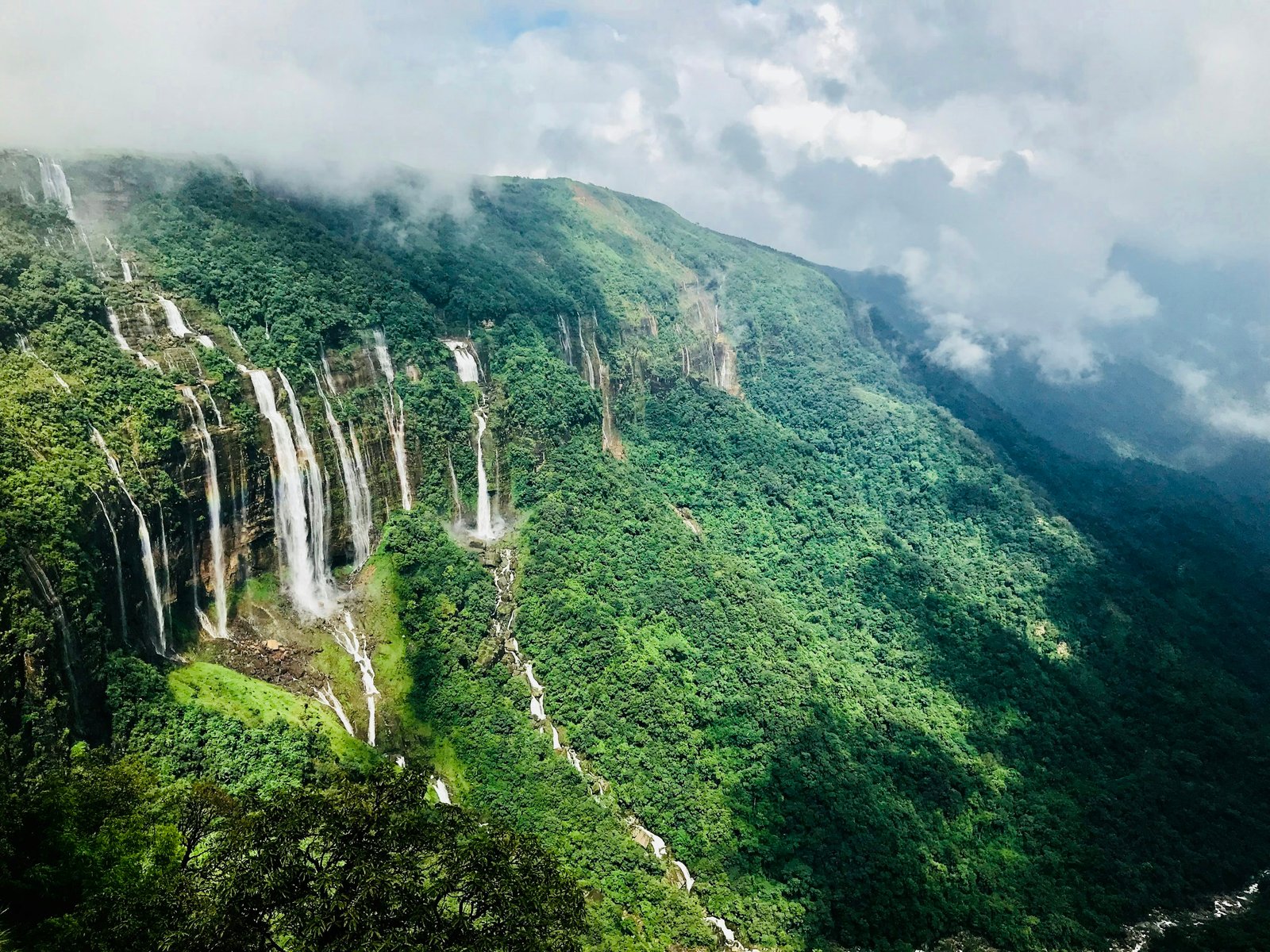
Stay for the late afternoon light at a viewpoint rather than trying to rush every waterfall. Sohra changes character when the mist moves; the same cliff can look calm, then suddenly theatrical.
PHOTO_SOHRACliffs, cloud and waterfalls near Cherrapunji
PHOTO_SOHRA
Sohra · cave mornings · waterfall evenings
Jowai & Jaintia Hills
The quieter turquoise side of Meghalaya
Jowai and the surrounding Jaintia Hills give the package a different colour: less crowded, more open, and often startlingly blue. This is the section for travellers who want a calmer tempo and a few places that feel almost secret.
Here, the itinerary can stretch to Krang Suri Falls, Ialong, Nartiang Monoliths and optional village time near the road to Dawki or Shnongpdeng. Jowai town is a practical overnight stop because it keeps the next day flexible and avoids a tiring return drive.
The Jaintia Hills also reward travellers who like local food and slower markets. This is where the trip becomes less about grand viewpoints and more about the ordinary details that stay in memory: tea stops, wet stone, roadside bananas and the sound of water below the road.
Build in a slower lunch stop near Jowai and keep the afternoon light for the waterfall visit. The turquoise colour looks best when the day is bright but not harsh.
PHOTO_JOWAIBlue water, forest edge and Jaintia Hills mood
PHOTO_JOWAI
Jowai · Krang Suri side · slow nature stop
Local food with place names
Eat the journey as you move through it
Good Meghalaya trips do not ignore food stops. The dishes are part of the geography: rice and pork in the cities, smoky flavours in the hills, sesame and fermented notes in family kitchens, and tea breaks that warm the body after mist and rain.
Shillong · Police Bazar / Laitumkhrah
Jadoh
The rice-and-meat comfort dish that shows up everywhere but tastes best in a busy city lunch stop. In Shillong, it feels like the taste of the hills settling into everyday life.
Shillong & Sohra · family kitchens
Dohneiiong
Pork cooked with black sesame gives a deep, nutty richness. It is the dish many travellers remember after a cold, wet day because it tastes warm, earthy and complete.
Jowai · Jaintia Hills town eateries
Tungrymbai
Fermented soya bean preparation with a strong local character. It is not a tourist dish; it is part of how the hills eat at home, especially with rice and vegetables.
Shillong breakfast stalls
Pukhlein
Sweet, crisp and satisfying, pukhlein works beautifully with tea in the morning before a road journey. It is an easy introduction to Khasi food for first-time visitors.
Sohra · roadside tea stops
Dohkhlieh / smoked snacks
After a cave visit or a viewpoint stop, simple savoury plates and tea feel especially good. The pleasure here is not luxury; it is the balance of warm food and cool air.
Mawphlang & village stops
Tea, rice cakes and local greens
Ask your guide where local families eat. In Meghalaya, the best meals are often the ones with a story attached to the village and the person who cooked them.
Stories most brochures skip
Why the hills feel sacred, not just scenic
The Nohkalikai legend
Travel books mention the height of the falls, but local memory gives them emotional weight. The name is carried with a story that many visitors hear only when a guide decides to tell it slowly, at the edge of the viewpoint.
Mawphlang sacred grove rules
Sacred groves are not just botanical spaces; they are governed by community belief and care. The point is not to extract from the forest, but to enter it respectfully and leave it whole.
Caves as memory archives
Meghalaya’s caves hold more than adventure. They hold geological time, local stories and a physical reminder that the hills are older than the roads laid across them.
Why locals move slowly in the rain
Rain is normal here, not an interruption. It changes schedule, light and conversation. Travellers who match that rhythm usually enjoy Meghalaya more than travellers who fight it.
Suggested itinerary
A route with breathing room, not rush
This version is built to feel balanced and immersive. You can shorten it, but the route reads best when each region gets enough time to unfold.
Day 1Arrival in Shillong · easy city evening+
Arrive, check in and keep the first day gentle. Take a city walk, have coffee or tea in Laitumkhrah, and save energy for the hills. This day is about orientation, not over-sightseeing.
Day 2Shillong → Sohra · caves and viewpoints+
Drive to Sohra, stopping for scenic pauses. Visit Mawsmai Cave and nearby viewpoints, then continue to Arwah or the Garden of Caves depending on timing and weather.
Day 3Sohra waterfall day · Nohkalikai, Wei Sawdong, Seven Sisters+
Use the clearest light for the main waterfall circuit. This is the best day for photography, storytelling and slow viewpoints rather than tight scheduling.
Day 4Jowai / Jaintia Hills · Krang Suri and rural stops+
Head to Jowai for a quieter palette of turquoise water and countryside. Add Nartiang or a village lunch stop if you want the route to feel fuller and more local.
Day 5Mawphlang Sacred Grove / Shillong return+
Finish with a quieter nature stop and return to Shillong or the airport side, depending on your departure plan. This day keeps the journey respectful and unrushed.
If you want more river colour and a longer Northeast experience, we can extend the plan towards Dawki and the living root bridge belt.
What is included
A proper tour package should remove friction
🚙
Private vehicle for the full routeNo shared transfers; the itinerary moves at your pace.
🛏️
Suggested stay planning by locationShillong for city nights, Sohra for waterfall days, Jowai for the Jaintia Hills side.
🧭
Local route guidanceUseful timing tips for caves, viewpoints and waterfall light.
📞
Sanoli WhatsApp coordinationSupport before and during travel for plan changes and updates.
🥐
Breakfast planningBuild the day around sensible food stops and early starts.
📸
Photography-friendly pacingMore time at the right viewpoints instead of too many rushed stops.
🗺️
Custom extension optionsCan be linked with Dawki, Shnongpdeng, Mawphlang or root bridges.
✅
Practical exclusions explained clearlyFlights, personal expenses, entry fees and boating can be itemised transparently.
International guest voices
A few sample review slots for the page layout
Replace these with approved testimonials from your real travellers before publishing.
★★★★★
“The Sohra day felt like travelling inside weather. We had caves, waterfalls and a proper local meal, not a rushed checklist. The pace made the place unforgettable.”
🇬🇧
Emily R.United Kingdom · Nature traveller
★★★★★
“Krang Suri was the moment we kept talking about for the rest of the trip. The colour of the water looked unreal, but the itinerary gave us time to enjoy it properly.”
🇫🇷
Lucas M.France · Photography visitor
★★★★★
“We loved that the package explained the stories behind the places. It felt like a guidebook, a comfortable tour and a cultural introduction all in one.”
🇺🇸
Sophia T.United States · Family trip
Frequently asked questions
The practical questions travellers ask first
October to April is usually the most comfortable travel window. The roads are easier, cave visits feel more pleasant and the light is good for viewpoints and photography.
Yes, with sensible pacing. The route is private, can be shortened when needed, and can be adjusted to reduce walking while keeping the scenic value strong.
For some stops, a local guide makes the visit safer, smoother and more meaningful. Sanoli can arrange local guidance depending on the final itinerary and date.
Shillong works best for the first city nights, Sohra for the major waterfall and cave day, and Jowai for the Jaintia Hills section. Boutique hotels, resorts and homestays can all be matched by area.
Yes. The route can be extended to Dawki, Shnongpdeng, Nongriat or Mawphlang if you have an extra day or want a richer Northeast experience.
Water levels change by season. Monsoon and post-monsoon bring the strongest flow, while winter offers clearer skies and easier movement. The best plan depends on whether you prioritise water volume or road comfort.
Expect fresh, rice-based meals, smoky pork dishes, fermented flavours and a lot of tea stops. The cuisine is local, distinctive and worth planning into the day instead of treating it as a side note.
Yes. The page has been written with the destination story, searchable headings, FAQ structure, schema markup and location-led content that works for both readers and search engines.
Make Meghalaya feel unforgettable before the journey even begins
This package page is written to sell the trip and teach the place at the same time. It can be pasted into WordPress as a single HTML block, and the image slots, FAQ schema and itinerary structure are already built in.