
🇮🇳 At a Glance — What Is India?
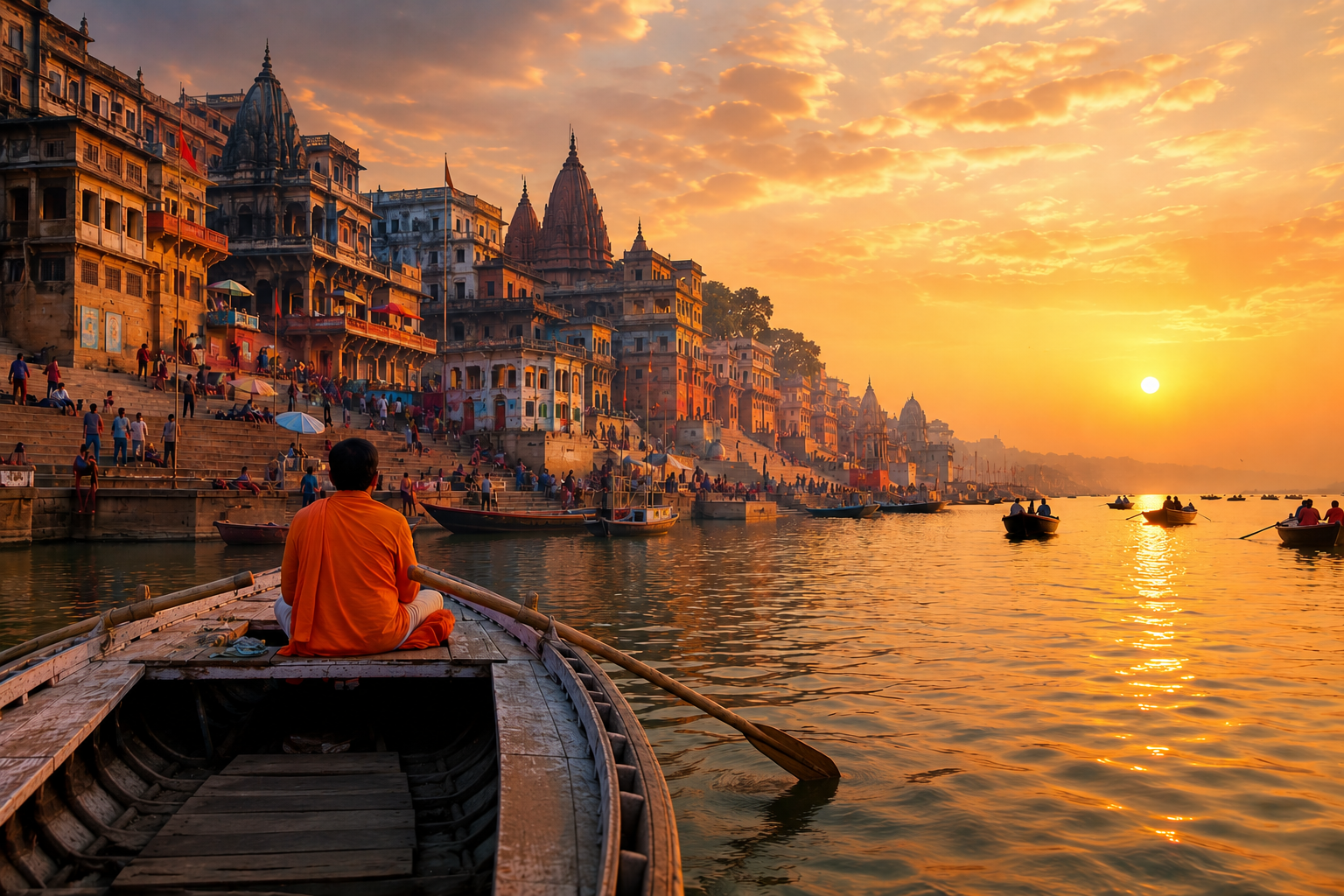
Every year, millions of people type three words into Google: "Is India safe?" Behind that search is curiosity, a little apprehension, and often a great deal of Western media conditioning. The news cycle loves drama. It rarely covers the 99.99% of days when India is exactly what it has been for 5,000 years — a warm, ancient, deeply spiritual civilisation that welcomes every stranger as a guest, calls its land a mother, and builds temples not merely as places of worship but as living universities of science, mathematics, astronomy, and philosophy.
This article is not a tourist brochure. It is a genuine, deeply researched answer to both questions: Is India safe? and What is India? — because you cannot answer the first without truly understanding the second.
Understand India and you understand something about humanity itself. It is the only civilisation that has been continuously alive, breathing, and teaching since before Rome was founded, before Greece wrote its first play, before the Bible was written.
— Shashi Tharoor, Member of Parliament & Author, An Era of DarknessUnderstanding the Scale: 1.48 Billion People Is Not Like Anywhere Else on Earth
Before anything else, you need to hold one number in your mind: 1,480,000,000. That is India's population as of 2024. Say it slowly. One billion, four hundred and eighty million people. That is more than the United States (335 million), the United Kingdom (68 million), Canada (39 million), and Australia (27 million) combined — four times over.
Now think about what that number means for diversity. The UK has broadly one language, one dominant culture, and a history of roughly 2,000 years of recorded civilisation. The United States has a recorded political history of about 250 years. India has over 5,000 years of continuous civilisation, 28 states, 8 union territories, 780+ languages and dialects, 6 major world religions born on or adopted into its soil, and cultural traditions so diverse that a person from Kerala and a person from Kashmir can be as different from each other as a Portuguese person is from a Norwegian — yet both call themselves Indian.
🌏 The Diversity Analogy
India's 28 states are better understood as 28 different countries sharing one passport. Each state has its own language, cuisine, dress, dance form, music, marriage traditions, and in many cases, a different script. Comparing Tamil Nadu's cuisine to Punjab's cuisine is like comparing Italian food to Scandinavian food. The India in Bollywood films is not the India of Mizoram. The India of Rajasthan's palaces is not the India of Andaman's tribal islands. There is no single "India experience" — there are hundreds.
| Country | Population | Languages | Religions | Area (km²) |
|---|---|---|---|---|
| India | 1.48 Billion | 780+ | 6+ major | 3.29 Million |
| United States | 335 Million | 1 official | 1 dominant + minorities | 9.83 Million |
| United Kingdom | 68 Million | 1 official | 1 dominant + minorities | 0.24 Million |
| Australia | 27 Million | 1 official | 1 dominant + minorities | 7.69 Million |
UN Population Data →
When Western Cities Riot After Football Matches — And Nobody Questions the Country's Safety
Here is something worth thinking about. Every time a major cricket match or local clash happens in India and makes international news, the West asks: "Is India safe?" But when European cities erupt after football matches — which happens with extraordinary regularity — no travel journalist writes "Is England safe?" or "Is France safe?" This double standard is worth examining, not out of defensiveness, but because it reveals how profoundly context shapes our perception of "safety."
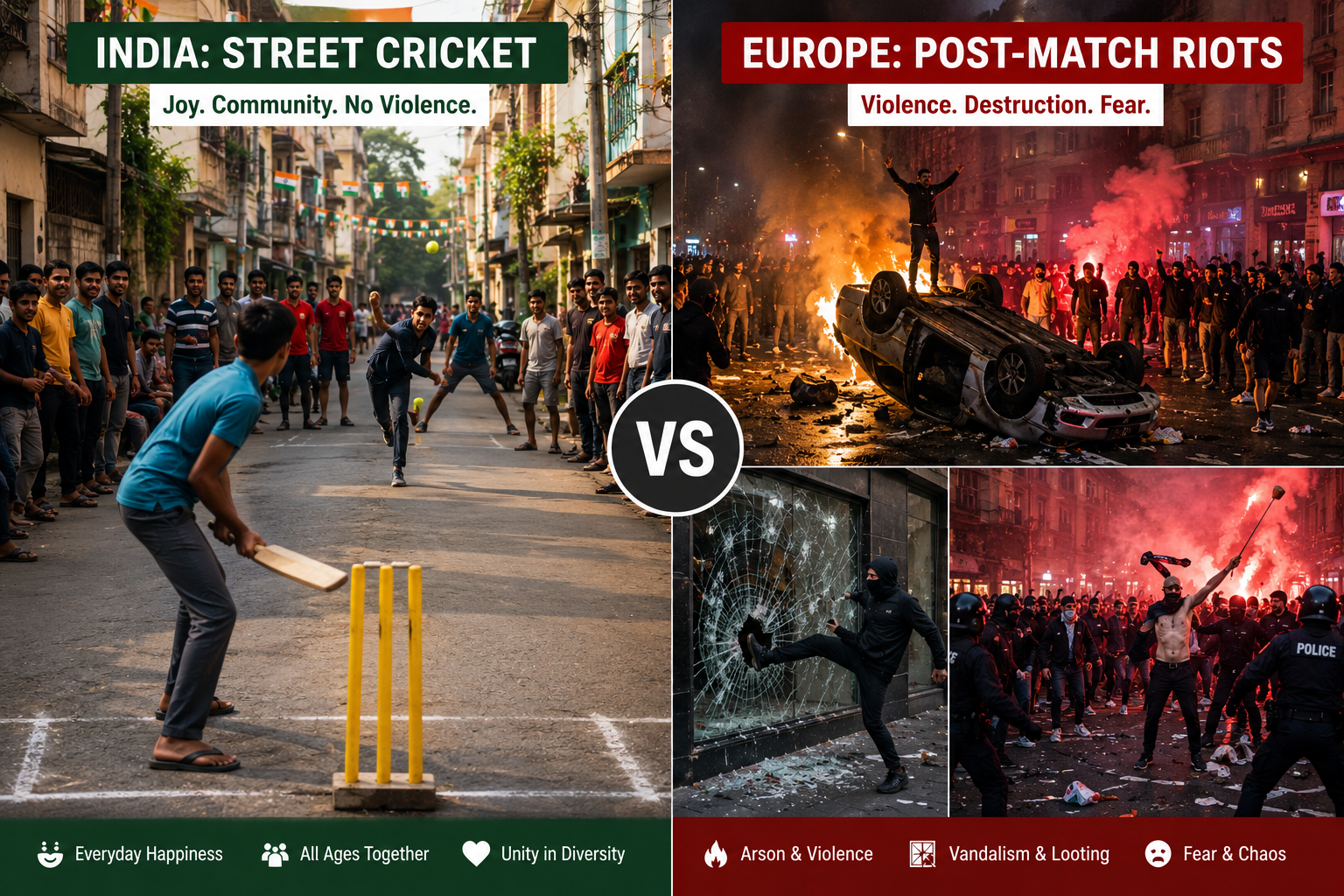
Consider these documented incidents from Western nations:
📰 Documented Post-Match Violence in Western Cities
- London, 2021 (Euro 2020 Final): After England's loss to Italy, fans stormed Wembley, 49 police officers were injured, 53 people arrested, and widespread vandalism was reported across London. The Met Police called it "an absolute disgrace." Yet no travel warning was issued for the UK. BBC Report →
- Paris, 2022 (Champions League Final): The Champions League final between Liverpool and Real Madrid descended into chaos outside Stade de France. Thousands were teargassed, fans were attacked, and children were caught in stampedes. French authorities and UEFA exchanged blame. The Guardian →
- Vancouver, 2011 (Stanley Cup): After the Vancouver Canucks lost the Stanley Cup, the city erupted into full-scale riots — cars were burned, stores were looted, and over 100 people were injured. Cost of damage: estimated $5 million CAD. Wikipedia →
- Rotterdam, 2015 (Europa League): Feyenoord supporters clashed with Roma fans in a night of violence that left multiple people hospitalised and the Dutch government facing international embarrassment.
- England (Recurring): English football hooliganism is so historically documented it has its own Wikipedia category, its own BBC documentaries, and its own academic sociology papers. The 1985 Heysel Stadium disaster killed 39 people.
Now consider: India's population is 22× the size of the UK. If the UK has regular post-match riots with 68 million people, the statistical equivalent in India would be vastly more frequent — yet it is not. India's cricket culture — arguably the world's most passionate — is a largely celebratory affair. In India, cricket wins are met with fireworks, mithai (sweets), and dancing. Losses are met with sadness, not arson.
The world judges India by its worst incidents and judges itself by its best intentions. That is not journalism — that is confirmation bias at a civilisational scale.
— Pankaj Mishra, Author & Cultural CriticDifferent States, Religions, and Habits: Why Indian Behaviour Cannot Be Generalised
A tourist who visits Mumbai, goes to Amritsar, then drives to Nagaland has essentially visited three different cultures, three different cuisines, three different worldviews — and sometimes three different scripts. To say "Indians behave this way" is as meaningless as saying "Europeans behave this way" and using that to describe both a Sicilian farmer and a Swedish banker in the same breath.
🗺️ India's Internal Diversity — A Quick Map
| Region / State | Primary Language | Cultural Character | Food Tradition |
|---|---|---|---|
| Punjab | Punjabi | Exuberant, generous, celebratory | Wheat-based, dairy-rich, non-veg |
| Kerala | Malayalam | Measured, scholarly, deeply ecological | Rice, coconut, seafood |
| Rajasthan | Rajasthani / Hindi | Regal, hospitable, colourful | Vegetarian, dal-baati, ghewar |
| Bengal | Bengali | Artistic, intellectual, passionate | Fish, rice, mishti (sweets) |
| Tamil Nadu | Tamil | Ancient, proud, deeply classical | Rice, sambar, idli, dosa |
| Nagaland | Nagamese + tribal | Community-centric, nature-bound | Rice, fermented pork, bamboo shoot |
| Gujarat | Gujarati | Entrepreneurial, strictly vegetarian | Dhokla, thepla, farsan |
| Kashmir | Kashmiri / Urdu | Meditative, poetic, connected to land | Wazwan, rice with mutton |
The religion map is equally layered. India is the birthplace of Hinduism, Buddhism, Jainism, and Sikhism — four world religions. It is also home to one of the world's oldest Jewish communities (Cochin Jews, dating to 70 CE), one of the earliest Christian communities (the St. Thomas Christians of Kerala, founded circa 52 CE, predating most European Christian communities), one of the world's largest Muslim populations, and the world's largest Zoroastrian (Parsi) community.
The Positive India: Brotherhood, Sisterhood, and the Culture of "Aapka Kya Kaam Hai?"
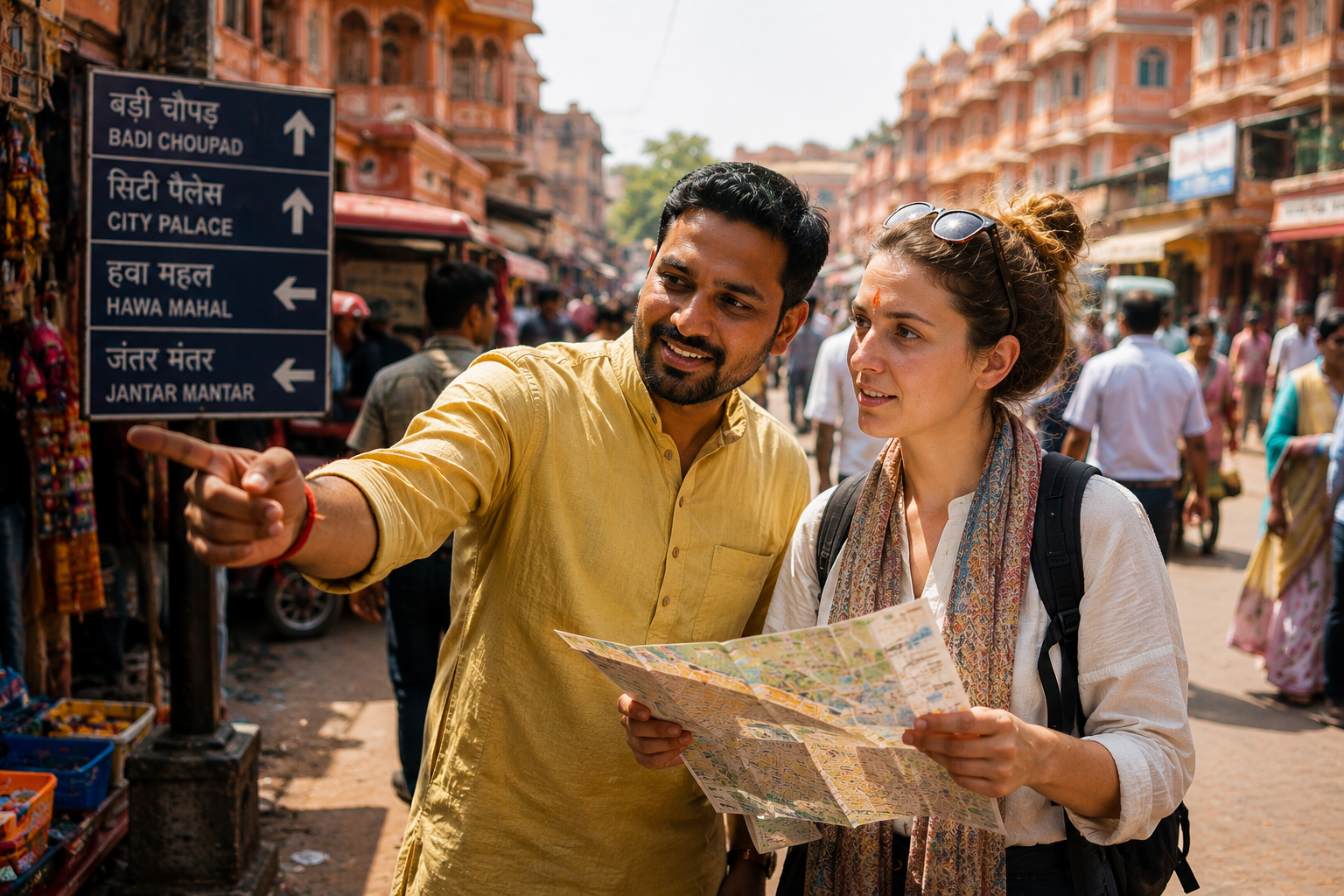
Walk into any Indian town and ask for directions. You will not get a point and a vague wave. You will get an escort. The person will walk you to your destination, sometimes half a kilometre out of their way, and refuse payment or even acknowledgment. This is not unusual behaviour — it is the default. India runs on a social operating system that defaults to helpfulness.
The concept behind this is ancient: Vasudheva Kutumbakam — a Sanskrit phrase from the Maha Upanishad meaning "The entire world is one family." This is not a political slogan. It is a philosophical position embedded in how most Indians were raised to relate to the world — including strangers.
The "No Money Challenge" Experiments — YouTube's Most Heartwarming India Videos
In recent years, a fascinating genre of YouTube content has emerged: foreign visitors or Indian YouTubers conducting a "no money challenge" — going into cities with nothing and relying purely on the generosity of strangers. The results are consistently, overwhelmingly moving.
📱 Documented "No Money" and Kindness Challenge Videos in India
- Gaurav Taneja (Flying Beast) and multiple Indian YouTubers have conducted experiments where they pretend to be lost or broke in cities — from Delhi to Varanasi to Jaipur. The response is consistently: strangers offering food, money, shelter, and accompaniment.
- Karl Rock, a New Zealand YouTuber who lives in India, documented repeatedly being offered meals, tea, and help by complete strangers across multiple Indian cities. His channel has over 1.5 million subscribers and his India content consistently shows the country's extraordinary warmth. Karl Rock on YouTube →
- Foreigner in India Challenge: Multiple viral videos show foreign tourists — particularly women — being helped, escorted, fed, and housed by strangers in India when in distress. This happens not in curated tourist hotels but in ordinary neighbourhoods, train platforms, and rural areas.
- Miss Excel (USA) and others: Numerous American and European travel vloggers have documented being overwhelmed by unsolicited kindness in India — from auto drivers refusing extra fare to strangers buying their train tickets when they realised the foreigner was confused.
- Sourav Joshi Vlogs conducted a hunger experiment walking through Uttarakhand villages — within minutes, multiple households independently offered food and refused payment. With over 25 million subscribers, his content is a living document of India's hospitality culture.
"In India, I have never been so lost and so immediately helped in the same moment. A city of 20 million people, and within five minutes a complete stranger had put me in a tuk-tuk and paid for it himself." — Travel blogger, Reddit r/solotravel (widely shared post, 2022)
Women as Goddesses: The Only Civilisation That Worships the Divine as Female
In the entire arc of human history, no civilisation has embedded the worship of the feminine divine as deeply into its spiritual and social architecture as India. This is not symbolic — it is structural. The primary forces of the universe in Hindu philosophy are female: Saraswati (knowledge), Lakshmi (wealth), Durga/Kali (power and destruction), Parvati (love and devotion). The Earth itself is Bhumi Mata. India itself is Bharat Mata. The sacred river is Ganga Ma.
The Science Behind Touching Feet (Charan Sparsh)
One of the most misunderstood of all Indian customs to the Western eye is the act of touching the feet of elders — parents, grandparents, teachers, respected elders, and even certain visitors. Called Charan Sparsh (चरण स्पर्श — "touching feet"), this act is ancient, universal across Indian cultures, and has a remarkable scientific and physiological basis.
🔬 The Science of Charan Sparsh — Why Touching Feet Is Profound
- Neural circuit completion: When you bow and touch someone's feet, your body forms a bow — head toward the ground, spine curved. Neuroscience shows that this posture activates the parasympathetic nervous system, reducing cortisol (stress hormone) and promoting calm. The person receiving the gesture also benefits — the neural response to being deeply respected triggers serotonin production.
- Energy meridians (Ayurvedic basis): Ayurveda maps the body as a field of energy meridians. The head and feet are the two poles of the human energy circuit. When the head (seeker) approaches the feet (elder), a circuit is conceptually completed — a flow of wisdom and blessing from the elder to the seeker. The elder's "Ashirvad" (blessing) in this moment is considered energetically real.
- Humility as cognitive reset: Physically lowering your head below another person's waist is a neurological "reset" of ego and status thinking. Studies in cognitive psychology show that physical postures of humility measurably shift mental states — reducing arrogance, increasing empathy, and triggering prosocial behaviour.
- Tactile connection: Human touch — particularly across generations — releases oxytocin (the "bonding hormone") in both parties. The ritual of Charan Sparsh is essentially a scientifically grounded inter-generational bonding ceremony performed multiple times a year.
- Acupressure points: The feet contain some of the most concentrated nerve endings and acupressure points in the body (the basis of reflexology). An elder who accepts this gesture often places their hand on the bowing person's head — pressing lightly on the crown, which in both Ayurveda and acupressure maps to major energy centres.
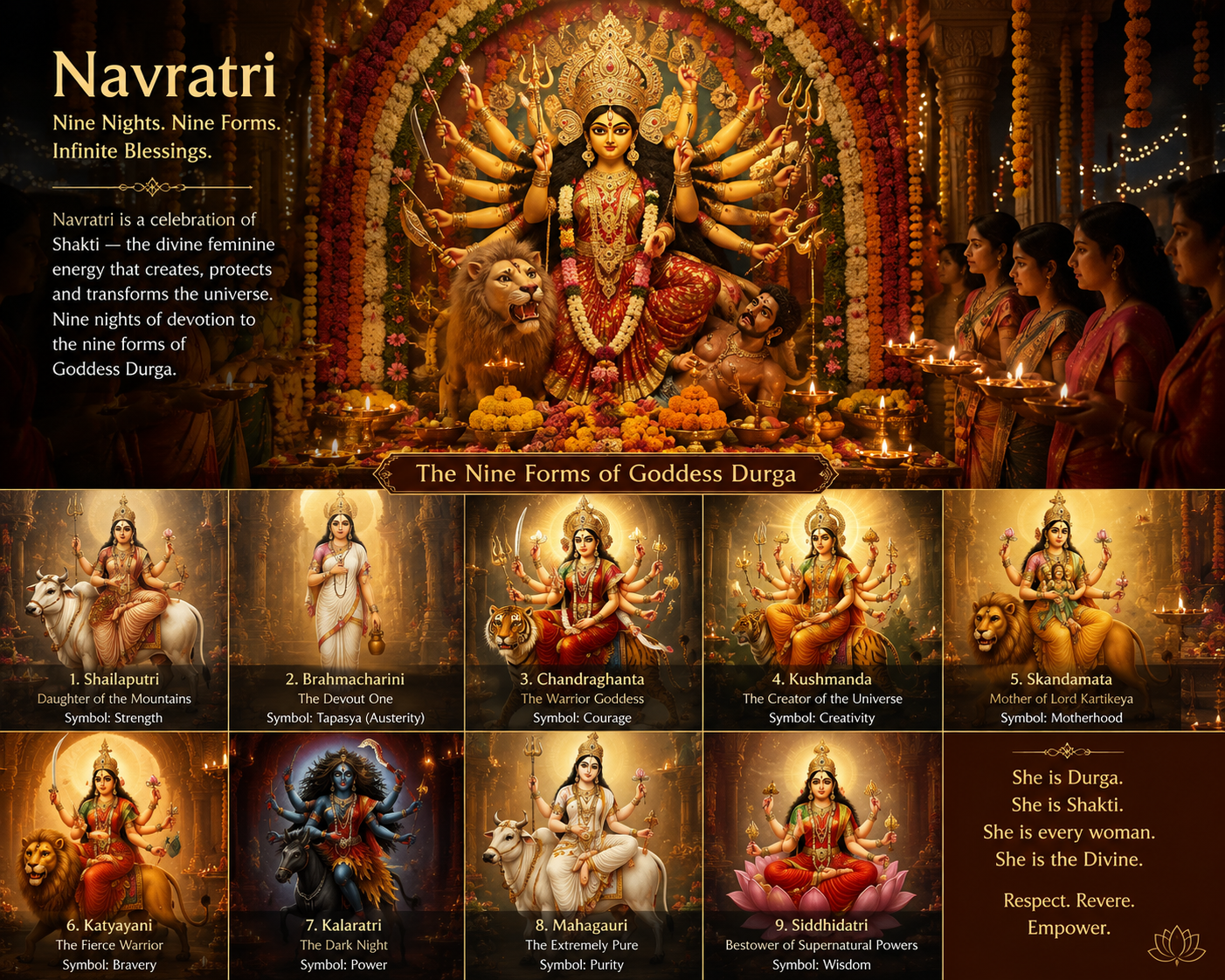
The Nine Forms of the Goddess: Navratri
Navratri — celebrated twice a year (once in spring, once in autumn) — is literally nine nights dedicated to nine forms of the divine feminine. Hundreds of millions participate. Young girls are worshipped as living embodiments of the goddess in the Kanya Puja ritual — fed, gifted, and honoured. The message embedded in this practice across 5,000 years: the female is divine. The young girl is a goddess. She must be treated as such.
The Science of Eating With Your Hands — And Why Not All of India Does It
Eating with hands is one of the first things that surprises international visitors to India. For much of the Western world, hands = unclean. For much of traditional India, hands are the most sacred utensil. Let us look at both the science and the nuance.
🖐️ The Ayurvedic and Scientific Case for Eating With Hands
- Nerve endings and temperature sensing: The nerve endings in your fingertips are extraordinarily sensitive to heat and texture. When you handle food before eating it, your brain receives real-time information about the food's temperature, texture, and readiness. This pre-eating neural engagement actually primes the digestive system — triggering earlier and more effective secretion of digestive enzymes.
- The Pancha Bhuta connection (Five Elements): In Ayurveda, the five fingers represent the five elements of the universe — Thumb (Fire/Agni), Index finger (Air/Vayu), Middle finger (Ether/Akasha), Ring finger (Earth/Prithvi), Little finger (Water/Jal). Eating with all five fingers connects the five elements of your body with the five elements present in food — creating a holistic energetic act of nourishment.
- Microbiome research: Emerging microbiome science suggests that the bacteria naturally present on clean human hands (specifically Lactobacillus species) can actually be beneficial when ingested with food — potentially aiding gut health. This is why many traditional Indian parents encouraged children not to obsessively sanitise before eating family food.
- Mindfulness: Eating with hands forces engagement. You cannot mindlessly scroll Instagram and eat with your hands simultaneously without making a mess. The tactile engagement forces a mindful eating state — which research in nutrition shows significantly improves satiety signals and reduces overeating.
⚠️ Important Nuance: Not All of India Eats With Hands
This is a critical misconception. Eating with hands is most commonly associated with South India (Tamil Nadu, Karnataka, Andhra Pradesh, Kerala, Telangana), where meals are often served on banana leaves, and rural/traditional homes across much of the country. But:
- Urban, restaurant-dining India — particularly in Delhi, Mumbai, Bengaluru — frequently uses cutlery.
- The Northeast (Meghalaya, Arunachal Pradesh, Manipur) has historically used utensils and chopstick-influenced tools.
- Many northern Muslim communities eat with spoons, especially with biryani and curry dishes.
- Parsi (Zoroastrian) households traditionally use European-style cutlery.
- Most Indian restaurants in the UK and US serve with cutlery — not because it is more correct, but because it is the local norm.
India, as always, defies generalisation.
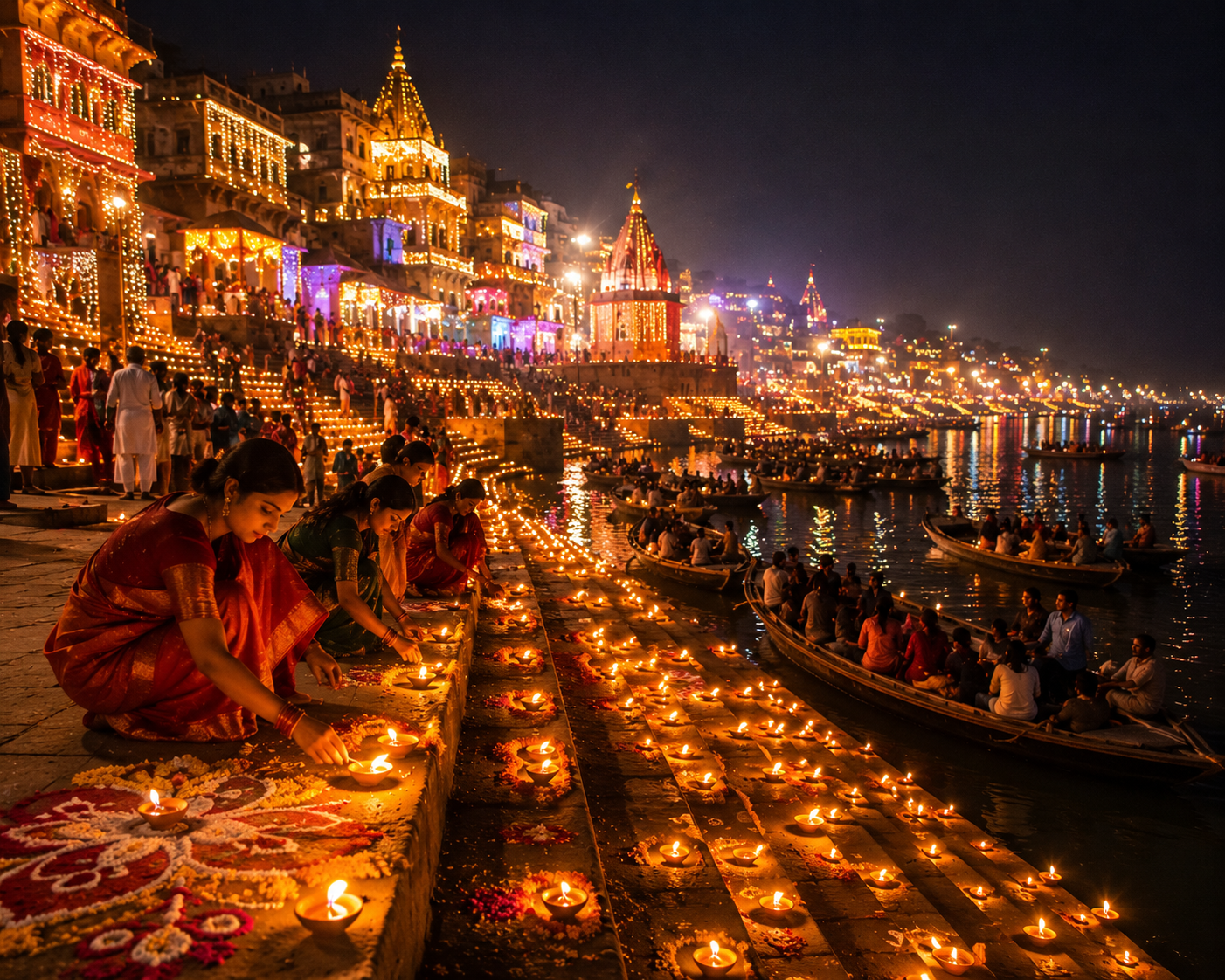
Festivals of India: Celebrations With 5,000 Years of Meaning
India has more public holidays and celebrated festivals than any other country on Earth. These are not merely cultural decorations. Each festival is a living lecture in astronomy, ecology, social psychology, or philosophy — encoded into ritual so that every generation re-learns the lesson through joy.
The Concept of Motherhood in India: When a Country Calls Itself "Maa"
In most countries, the nation is a concept — a political entity with borders and a government. In India, the nation is a mother. Bharat Mata — Mother India — is not a metaphor. It is a lived spiritual relationship. Indian soldiers have historically gone to battle with the phrase "Jai Bharat Mata" (Victory to Mother India) on their lips, not "for the government" or "for the nation-state," but for a figure of divine love.
🌸 The Layers of "Maa" in Indian Culture
- Ganga Ma: The Ganges river is not called "the Ganges River" in India — she is Ganga Ma (Mother Ganga). The river is a living goddess, a mother figure, a purifier. This is why the death of Ganga is treated as the death of a mother — with grief, not just environmental concern.
- Bhumi Mata: The Earth is Bhumi Mata — Mother Earth. Before ploughing, many Indian farmers still touch the earth and apologise for the disturbance — acknowledging that she is alive and sacred. This is the world's oldest sustainable agriculture philosophy.
- Gomata: The cow is Gomata — Mother Cow. In Vedic philosophy, the cow represents the Earth's abundance and gives without asking. Protecting the cow is protecting the ecology that sustains life.
- Guru Ma / Amba Ma: Female teachers, midwives, and elder women in villages are addressed as "Ma" — a form of respect that acknowledges their nurturing role in community.
- The Mother in the home: In the Indian family, the mother is the de facto spiritual head of the household. She is the first to wake, the last to eat, the keeper of the family's rituals, and the primary teacher of values to children. The phrase "Matru Devo Bhava" — "Mother is God" — is in the same Vedic text as "Atithi Devo Bhava" (Guest is God).
"In India, the mother is not merely a family member. She is the civilisation itself — its memory, its warmth, its continuity. Strip away the mother from Indian culture and what remains is just geography." — Amartya Sen, Nobel Laureate in Economics, Bengali poet-philosopher
The Bhagavad Gita and the Sacred Texts: India's Gift to Human Philosophy
The Bhagavad Gita — literally "The Song of God" — is arguably the most important philosophical document ever produced by human civilisation. Composed approximately 5,000 years ago (scholars debate the date, with conservative estimates placing it at 400–500 BCE for the written text, and oral origins much earlier), it is a 700-verse dialogue between the warrior prince Arjuna and Lord Krishna on a battlefield — about duty, death, reality, the self, and the nature of existence.
📚 What the Bhagavad Gita Teaches — And Why the World's Greatest Minds Revered It
- Albert Einstein reportedly said: "When I read the Bhagavad Gita and reflect about how God created this universe everything else seems so superfluous."
- J. Robert Oppenheimer (father of the atomic bomb) quoted the Gita in Sanskrit at the first nuclear test: "Now I am become Death, the destroyer of worlds" — Bhagavad Gita, 11:32. He carried a copy of the Gita throughout his life.
- Carl Jung wrote extensively about the Gita's psychological insights, noting that its analysis of ego, consciousness, and duty anticipated modern depth psychology by thousands of years.
- Henry David Thoreau wrote in his journal: "In the morning I bathe my intellect in the stupendous and cosmogonal philosophy of the Bhagavad Gita."
- Nikola Tesla was deeply influenced by Swami Vivekananda's explanations of Vedic philosophy and the concept of Prana (energy) and Akasha (ether) — concepts that influenced his work on electromagnetic energy.
Beyond the Gita, India's scriptural tradition is the most voluminous in human history. The four Vedas (Rigveda, Yajurveda, Samaveda, Atharvaveda), the 108 Upanishads, the 18 major Puranas, the Mahabharata (the world's longest epic poem at 1.8 million words — 10× the length of the Iliad and Odyssey combined), the Ramayana, and the 64 Agamas together represent a body of philosophical, spiritual, scientific, and narrative knowledge that has no equivalent anywhere on Earth.
Nalanda University: The World's First University — And the Three Months It Burned
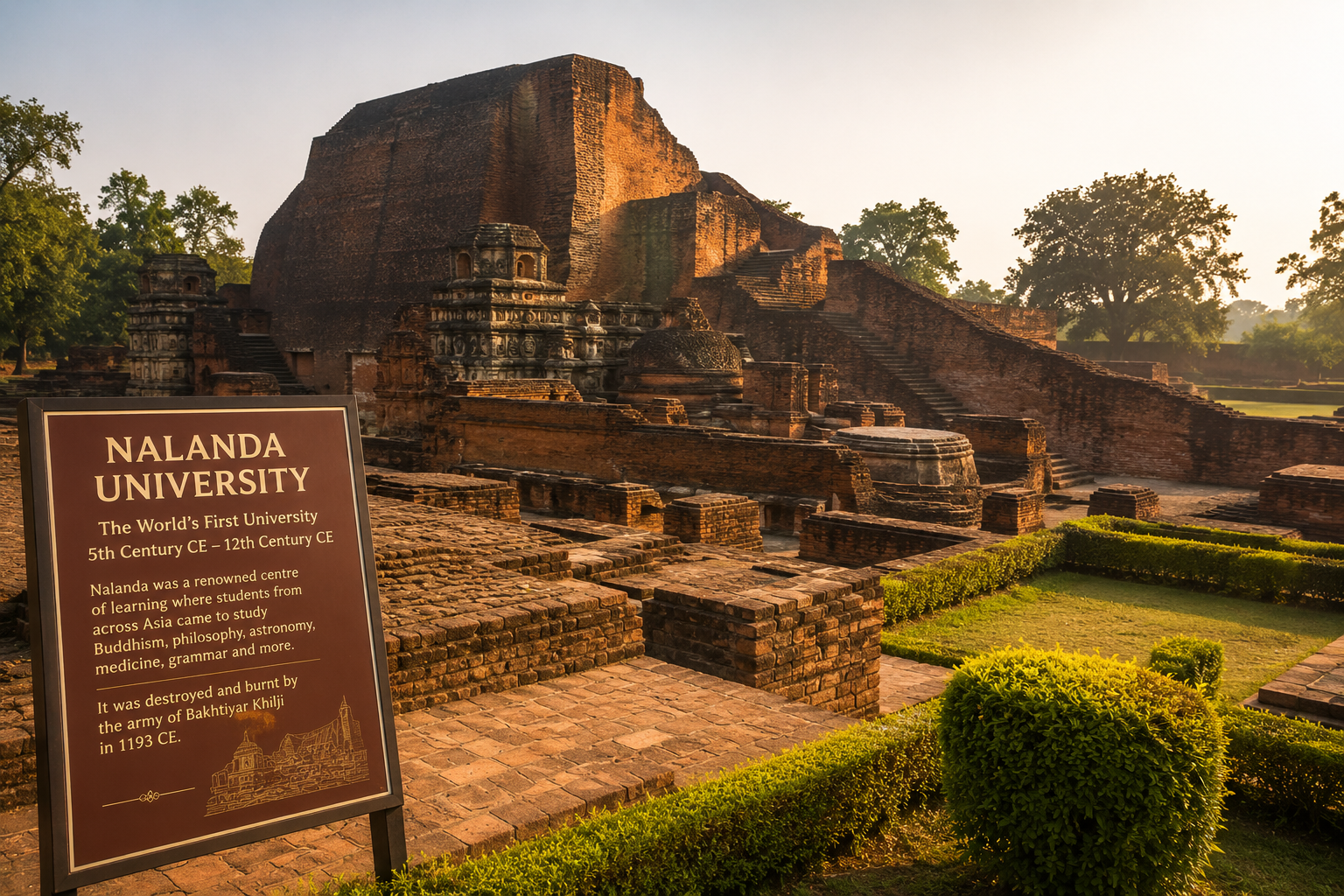
Before Oxford (founded ~1096 CE), before Bologna (founded 1088 CE) — before any European university existed — there was Nalanda. The world's first residential university. Its existence predates the Western concept of organised higher education by over 600 years.
🏛️ Nalanda University — The Facts That Stagger the Imagination
- Founded: Approximately 427 CE (some sources say 5th century CE), in Nalanda, Bihar, India.
- Active for: Approximately 700–800 years — longer than most modern universities have existed.
- Students at peak: Approximately 10,000 students in residence.
- Teachers: Approximately 2,000 faculty members.
- Admission: Only 20–30% of applicants were accepted, via a rigorous entrance examination conducted at the gate by a renowned scholar-gatekeeper.
- Subjects taught: Theology, logic, grammar, medicine (Ayurveda), astronomy, mathematics, literature, philosophy, linguistics.
- International students from: China, Japan, Korea, Sri Lanka, Tibet, Indonesia, Persia, Turkey — making it the world's first international university.
- Famous alumni: Xuanzang (Chinese scholar whose accounts of Nalanda are our primary source), Dharmakirti (logician), Shantarakshita (philosopher-abbot of the first Tibetan monastery).
- Library — Dharmaganja: Three multi-storey buildings called Ratnasagara (Ocean of Jewels), Ratnodadhi, and Ratnaranjaka — so immense that when they were set on fire, they burned for three months.
The Burning of Nalanda: A Crime Against Human Knowledge
In 1193 CE, the Turkic military commander Bakhtiyar Khilji led a raid into Bihar during his campaign of conquest across northern India. His forces burned Nalanda. When his soldiers asked the monks what the burning books were (not recognising they were books of knowledge and not religious texts), the monks reportedly said they were "the words of the divine." And so the fires continued.
Tibetan Buddhist historian Taranatha, writing in the 16th century based on earlier sources, recorded that the Dharmaganja library burned for three months — such was the volume of manuscripts accumulated over 700 years. What was destroyed? We will never fully know. But historians believe the losses included:
📜 What Was Likely Lost in the Burning of Nalanda (1193 CE)
- Thousands of manuscripts on Ayurvedic medicine — possibly including surgical and pharmacological knowledge that would not be independently rediscovered in Europe for centuries.
- Mathematical texts — India had independently developed the concept of zero, the decimal system, trigonometry, and algebra well before their "discovery" in the West. How much more was there?
- Astronomical records going back centuries — India's astronomical tradition (Jyotisha) is among the world's oldest and most sophisticated. The Nalanda scholars were making calculations about planetary motion and eclipses with remarkable accuracy.
- Logical and epistemological treatises — the Nalanda school of Buddhist logic (Pramana tradition) was the most sophisticated school of logical thought in the ancient world at its time.
- Linguistic and phonological works — Sanskrit grammarian Panini's Ashtadhyayi (5th century BCE) created a generative grammar of Sanskrit so precise that modern computational linguists use it as a model. How much more was built on this foundation?
Nalanda was a UNESCO World Heritage Site, inscribed in 2016. The Nalanda University Act was passed by the Indian Parliament in 2010. A new Nalanda University campus opened in Rajgir, Bihar in 2024 — symbolically rebuilding what was destroyed. Prime Minister Narendra Modi inaugurated the new campus on June 19, 2024.
India's Ancient Medical Science: The World Learned From India
When we talk about "modern medicine," we tend to assume it began in Greece with Hippocrates (460–370 BCE). But the evidence increasingly shows that India's medical tradition — Ayurveda — is older, and in several respects, more sophisticated. Let us look at what India was doing medically before most of the world had systematic medicine at all.
"Sone ki Chidiya" — The Golden Bird: How Much Was Taken From India, and by Whom
For thousands of years, India was known across the world as "Sone ki Chidiya" — the Golden Bird. This was not a metaphor. Before colonisation, India and China together accounted for approximately 50% of global GDP. At the height of the Mughal Empire (1700 CE), India alone accounted for approximately 25% of world GDP — more than all of Europe combined at the time.
The Guardian: Britain Stole $45 Trillion from India →
The Gold of India's Temples
India's temples were not merely places of worship. They were the economic and cultural anchor of their communities — functioning as granaries, hospitals, concert halls, schools, banks, and land banks. The wealth they accumulated over millennia is staggering.
🏛️ India's Temple Gold — Documented Examples
- Padmanabhaswamy Temple, Kerala: In 2011, the Supreme Court of India ordered an inventory of this temple's vaults. What was found in five of the six vaults: gold statues, gold coins, diamonds, emeralds, sapphires, and gold objects estimated at a combined value of over ₹1 lakh crore (approximately $22 billion USD) at 2011 values. The sixth vault (Vault B) remains sealed by court order. Archaeologists and historians believe Vault B may contain an even greater treasure. This is one temple in one state. BBC: Padmanabhaswamy Treasure →
- Tirupati Balaji, Andhra Pradesh: The Tirumala Tirupati Devasthanams temple receives approximately ₹1,000–1,200 crore (USD 130–150 million) in annual donations. It holds approximately 10,000 kg of gold in its possession — one of the largest gold holdings of any institution in the world. The temple feeds approximately 50,000–75,000 pilgrims daily for free.
- Somnath Temple, Gujarat: The original Somnath temple was so encrusted in gold and jewels that medieval Arab chronicler Al-Biruni described its spires as being visible from the sea. It was raided and partially destroyed 17 times throughout history — each time rebuilt. Mahmud of Ghazni's 1026 CE raid reportedly carried away wealth "that would take 20,000 camels to transport," according to the Persian historian Firishta.
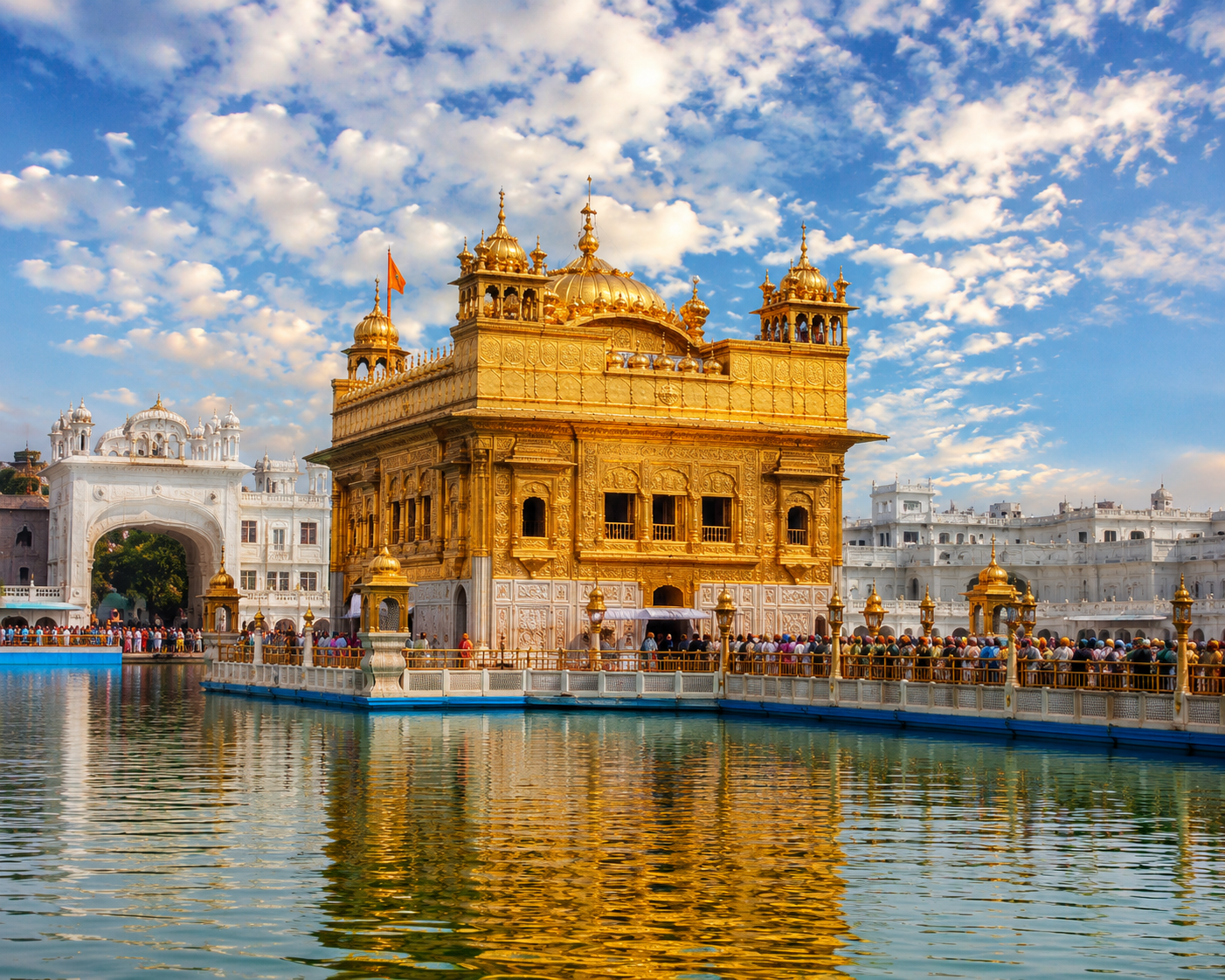
- Harmandir Sahib (Golden Temple), Amritsar: The Sikh Golden Temple is covered in approximately 750 kg of 24-karat gold, donated by Maharaja Ranjit Singh in the early 19th century. It feeds 100,000 people daily, every single day of the year, in the largest free kitchen (Langar) on Earth — regardless of religion, caste, or nationality.
What Was Taken: British Extraction From India (1757–1947)
The story of British colonisation of India is inseparable from the story of economic extraction. What took place between the Battle of Plassey (1757) and India's Independence (1947) was the most systematic transfer of wealth in human history.
📜 Key Methods of British Wealth Extraction From India
- The "Home Charges" system: From 1858 onward, the British government billed Indian taxpayers for the cost of British administration, including the salaries of British officials, British pensions, and the cost of wars fought in India's name — in other words, India paid for its own occupation.
- Deindustrialisation of Indian textiles: India was the world's largest textile producer in 1750, with Dhaka muslin (the world's finest fabric) and Calico prints exported worldwide. Britain destroyed Indian textile industries through punitive tariffs — Indian cloth exported to Britain was taxed up to 70–80%, while British cloth entered India near duty-free. This single policy destroyed the livelihoods of millions of Indian weavers and converted India from an industrial exporter to a raw-material supplier.
- The opium trade: Britain forced India to grow opium in Bengal and Bihar, then exported it to China — collecting revenue at both ends. Indian farmers had their food crops replaced with opium by force. The Bengal famine of 1943 — in which 2–3 million people died — was partly caused by Churchill's wartime grain export policy from India while Indians starved.
- Gold drain: British India had a persistent trade surplus (India exported more than it imported) but paradoxically became poorer — because the surplus was repatriated to Britain in the form of gold and silver rather than reinvested in India. This is the mechanism Patnaik's research documents so precisely.
The Islamic invasions that preceded British colonisation also had significant economic consequences. The repeated raids of Mahmud of Ghazni on Somnath (17 raids between 1001 and 1026 CE), the looting of the Delhi Sultanate, and the economic disruption of the Mughal wars cumulatively transferred enormous wealth out of the temple-and-trade economy that had sustained Indian prosperity. The historical record is not about vilifying any one group — it is about understanding why a country that was once the world's wealthiest is where it is today.
India's Temples: Not Just Houses of God — Living Universities of Science, Art, and Architecture
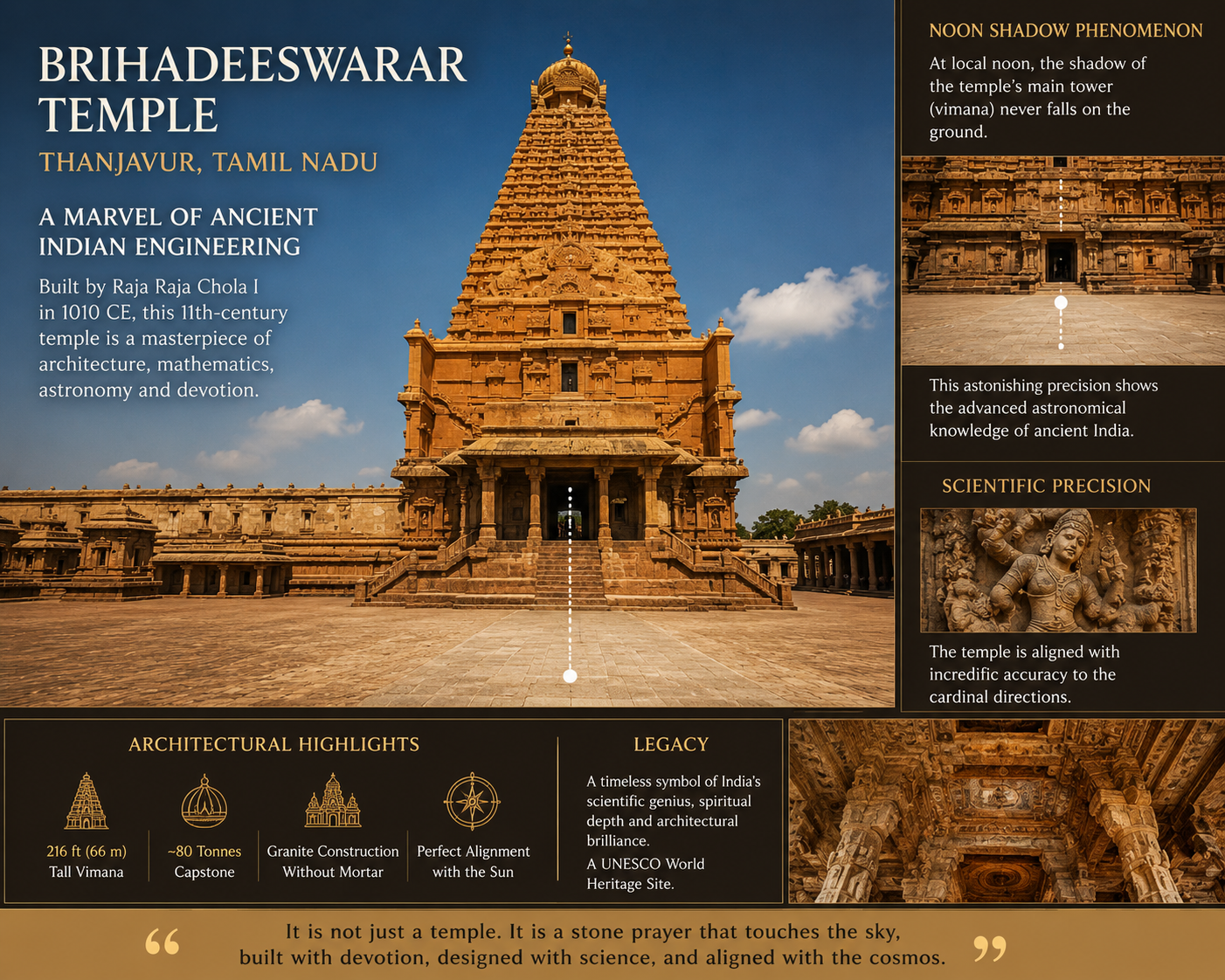
No discussion of India is complete without a genuine attempt to explain what an Indian temple actually is. To the Western eye, trained by the Christian conception of a church as a place of communal prayer, an Indian temple looks like an elaborate religious building. That is a profound misunderstanding. An Indian temple is simultaneously a physics laboratory, an astronomical calendar, a medical clinic, a concert hall, a school of art and dance, and a community welfare centre.
🔬 The Science Embedded in Temple Architecture
- Orientation: Every traditional Hindu temple is oriented East-West, with the main sanctum (Garbhagriha, literally "womb chamber") facing East to receive the first rays of sunrise. This is a solar calendar alignment — the exact sunrise direction shifts through the year, and temple entranceways are calibrated to specific solar or astronomical events.
- The Gopuram (Tower) as frequency amplifier: The tapering tower shape of South Indian temples is not merely architectural decoration. Research by acoustic engineers has shown that the concave-convex geometry of the gopuram creates specific acoustic resonance patterns — amplifying the sound of bells, drums, and chanting in ways that affect brainwave states in the surrounding area. This is essentially the world's oldest sound-engineering project.
- Copper and silver in the sanctum: The walls and floor of many traditional temple sanctums are lined with copper (and sometimes silver). Copper has well-documented antimicrobial properties — research published in journals including the Journal of Hospital Infection shows that copper surfaces kill bacteria including MRSA in hours. A copper-lined room is, from a microbiology standpoint, a sterile environment. The temple was, functionally, the community's cleanest room.
- The bell: Temple bells are cast from a specific alloy of seven metals (Panchadhatu or Saptadhatu) and tuned to frequencies that create a resonance lasting 7 seconds or longer. Modern neuroscience research shows that the 7-second resonance of a properly cast bell creates a simultaneous activation of the left and right cerebral hemispheres — inducing a meditative, focused state. It is an acoustic reset for the brain.
- The "Garbhagriha" (sanctum) — a microwave chamber?: The sanctum of a temple is traditionally small, dark, and stone-walled — seemingly austere. But architects and physicists studying temple construction have noted that the stone used is often a specific granite that has a high content of quartz crystals. Piezoelectric quartz generates electrical charges under mechanical stress (such as the vibration of chanting, bells, and drums) — potentially creating measurable energy fields in the sanctum. This is speculative but has attracted serious academic attention. Times of India: Science Behind Temple Bells →
- The Pradakshina (circumambulation) path: The path around the central sanctum is always clockwise (the direction of the sun's apparent movement). Walking clockwise is aligning your body with the Earth's rotation. Modern physics shows that moving in the direction of the Earth's rotation generates very slightly different gravitational forces than moving against it. In traditional terms, this clockwise alignment is called "anuloma" — going with the natural flow.
- Stepped wells and water management: India's ancient stepwell temples (Vav) — such as the Rani ki Vav in Gujarat (UNESCO World Heritage Site) — are marvels of hydro-engineering. The stepwell could handle monsoon floods and drought cycles, maintaining a constant accessible water level through 7–9 levels of descending steps. They were also temples, with elaborate carved panels at every level.
How Temples Were Destroyed — and Why It Matters
Understanding the destruction of India's temples is essential context for understanding the country's history. Over 1,000 years, multiple waves of invasion damaged or destroyed thousands of temples — not merely as military acts but as deliberate erasures of civilisation. The Somnath temple was raided 17 times. The Kashi Vishwanath temple in Varanasi was demolished twice and a mosque was built on its site in 1669 by Aurangzeb. The Ram Janmabhoomi in Ayodhya — the birthplace of Lord Ram — had its temple demolished in 1528 CE by the Mughal commander Mir Baqi on Babur's orders, and a mosque (the Babri Masjid) was erected in its place. The Supreme Court of India ruled in 2019 that the site was indeed the birthplace of Ram and ordered it returned for temple construction. The Ram Mandir was consecrated on January 22, 2024.
Why Hinduism Is Considered the World's Oldest Living Religion
Hinduism is the world's oldest living religion. Not the oldest belief system in archaeological history (that would be animistic shamanic traditions), but the oldest organised religion that is still actively practiced in substantially the same form, with substantially the same texts, rituals, and philosophical framework, as it was in antiquity. This is an extraordinary fact.
🕉️ Evidence for Hinduism's Antiquity
- The Rigveda — the oldest of the four Vedas and the oldest scripture still in active liturgical use — is dated by linguistic analysis and astronomical references to approximately 1500–1200 BCE (conservative estimate) or earlier. Some astronomers, using computer-aided astronomical dating of stellar positions mentioned in the Rigveda, place its composition as early as 4000–6000 BCE.
- The Indus Valley Civilisation (3300–1700 BCE) — which flourished in what is now Pakistan and northwest India — shows clear evidence of proto-Hindu worship: the swastika (an ancient symbol of auspiciousness, predating its Nazi appropriation by 5,000 years), the pashupati seal (showing a seated figure in a yoga posture, surrounded by animals — widely interpreted as proto-Shiva), ritual bathing tanks remarkably similar to modern temple tanks, and the lingam (a cylindrical object associated with Shiva worship).
- Continuous philosophical development: The Vedic period (c. 1500 BCE) → the Upanishadic period (c. 800–200 BCE) → the Puranic period (c. 300–1200 CE) → the Bhakti movement (c. 1200–1700 CE) → modern Hinduism. This is a 4,000-year continuous intellectual tradition. No other religion has a comparable timeline of active, unbroken philosophical evolution.
- Comparison with other major religions: Islam was founded in 622 CE. Christianity in approximately 30–33 CE. Buddhism around 500 BCE. Judaism's textual tradition begins around 1000–800 BCE. Hinduism's Rigveda predates all of these.
Is India safe to visit? Check your route and current advice
Safety depends on your destination, activities and circumstances. A tour booking cannot guarantee safety. Check official advice for every part of your route before booking and again before departure.
Official advice for US, UK and European visitors
The US State Department India advisory, checked on 10 October 2026, is Level 2: exercise increased caution. Some regions have stronger restrictions. It also advises against women travelling alone. Read the full regional and personal-safety guidance.
Check the UK FCDO India advice or your own country's foreign ministry. Advice differs by country and can affect insurance. Tourist arrival totals or national crime comparisons do not establish that a particular journey is safe.
Questions to ask when planning your trip
- Which destinations and roads are on the proposed itinerary, and are any affected by your government's advice?
- Who meets you at the airport, how do you identify the driver, and which contact handles changes?
- Are transfers scheduled in daylight where practical, and what happens if a flight is delayed?
- What support is included in your written quotation, and what does your travel insurance cover?
- Are planned walks, boats or temple visits suitable for your mobility needs and current local conditions?
Ask a qualified travel-health professional about your personal needs. Do not dismiss persistent illness as simply adjusting to a different climate or diet. Follow current official travel-health advice.
Why India Is the World's Most Ancient Living Civilisation
The word "ancient" is overused. Rome is called ancient, but the Roman Empire fell in 476 CE and Rome's civilisation as a continuous entity ended. Greece is called ancient, but modern Greek culture bears limited direct continuity with ancient Athens. Mesopotamia — often called the "cradle of civilisation" — exists today as modern Iraq, with its ancient civilisational traditions entirely replaced.
India is different. The Ganges river is mentioned in the Rigveda — and it is worshipped by name by the same people, in the same way, today. The Mahabharata's characters are household names across 1.3 billion Hindus today, as they were 2,000 years ago. The puja performed in a village in Rajasthan today uses the same Sanskrit mantras, the same ritual structures, and the same symbolic logic as puja performed 3,000 years ago. This is civilisational continuity without parallel anywhere on Earth.
India is not a country. It is a living library — the longest continuously-updated manuscript in human history, currently being written by 1.48 billion hands simultaneously.
— Adapted from Rabindranath Tagore's vision of India as a civilisational ideaIndia travel safety: frequently asked questions
Is India safe for solo women travellers?
Do not treat any destination or tour arrangement as a safety guarantee. The linked US advisory advises against women travelling alone. Review your own government's advice and discuss your route and transport arrangements before booking.
Does booking a private tour remove travel risks?
No. A clear itinerary and agreed transfers help with logistics, but they do not remove risks. Review regional advice, insurance, transport and support arrangements independently.
Where should I check current guidance?
Use your government's India travel advice and its region-specific notices. Recheck before departure and when changing your route. This article's safety section was reviewed on 10 October 2026.