
{
"@context":"https://schema.org",
"@type":"TouristTrip",
"name":"Andaman Luxury Hideaway",
"description":"Private island luxury in the Andaman archipelago — Radhanagar Beach Asia's finest, Havelock coral reefs, Neil Island solitude, Ross Island colonial ruins, bioluminescent kayaking, and world-class scuba. Ministry of Tourism recognised since 1991.",
"url":"https://sanoliindiatour.com/packages/andaman-luxury-hideaway",
"touristType":["Luxury Travellers","Divers","Honeymooners","Adventure Seekers"],
"itinerary":{
"@type":"ItemList",
"name":"Andaman Luxury Hideaway Itinerary",
"itemListElement":[
{"@type":"ListItem","position":1,"name":"Port Blair Arrival — Ross Island Colonial Ruins"},
{"@type":"ListItem","position":2,"name":"Havelock Island — Radhanagar Beach Sunset"},
{"@type":"ListItem","position":3,"name":"Elephant Beach Snorkelling — Coral Gardens"},
{"@type":"ListItem","position":4,"name":"Neil Island — Howrah Bridge Rock Arch"},
{"@type":"ListItem","position":5,"name":"Bioluminescent Kayaking — Midnight Ocean Glow"},
{"@type":"ListItem","position":6,"name":"North Bay Scuba — Andaman Coral Triangle"}
]
},
"provider":{
"@type":"TravelAgency",
"name":"Sanoli India Tours",
"url":"https://sanoliindiatour.com",
"telephone":"+919717278522",
"email":"sanoliindiatour@gmail.com",
"address":{"@type":"PostalAddress","streetAddress":"8, Suvidha Market, Netaji Nagar","addressLocality":"New Delhi","addressCountry":"IN"},
"taxID":"07AOJPS1151F4ZY",
"foundingDate":"1991"
},
"aggregateRating":{"@type":"AggregateRating","ratingValue":"4.9","reviewCount":"97","bestRating":"5"},
"offers":{"@type":"Offer","availability":"https://schema.org/InStock","validFrom":"2025-01-01"}
}
{
"@context":"https://schema.org",
"@type":"BreadcrumbList",
"itemListElement":[
{"@type":"ListItem","position":1,"name":"Home","item":"https://sanoliindiatour.com"},
{"@type":"ListItem","position":2,"name":"Tour Packages","item":"https://sanoliindiatour.com/tour-packages"},
{"@type":"ListItem","position":3,"name":"Andaman Packages","item":"https://sanoliindiatour.com/tour-packages?region=andaman"},
{"@type":"ListItem","position":4,"name":"Andaman Luxury Hideaway","item":"https://sanoliindiatour.com/packages/andaman-luxury-hideaway"}
]
}
{
"@context":"https://schema.org",
"@type":"FAQPage",
"mainEntity":[
{"@type":"Question","name":"What is the best time to visit the Andaman Islands?","acceptedAnswer":{"@type":"Answer","text":"The ideal window is October to May. December to February is peak season — skies are clearest, seas calmest, and underwater visibility can reach 40 metres. October–November and March–May are shoulder seasons with excellent conditions and fewer crowds. Avoid June–September: the South-West monsoon makes sea crossings dangerous and many water sports shut down. The Andaman Sea's monsoon arrives earlier and hits harder than mainland India's. Sanoli India Tours builds monsoon contingency plans into every itinerary."}},
{"@type":"Question","name":"Do I need a permit to visit the Andaman Islands?","acceptedAnswer":{"@type":"Answer","text":"Indian nationals do not need a permit for Port Blair, Havelock, Neil, or most tourist islands. Foreign nationals receive a 30-day Restricted Area Permit (RAP) free of charge on arrival at Port Blair airport — no advance application needed. Certain tribal reserve islands (North Sentinel, Jarawa reserve areas) are permanently closed to all visitors. The only islands requiring special advance permits are Barren Island (active volcano) and some remote dive sites. Sanoli India Tours handles all documentation and pre-arrival logistics."}},
{"@type":"Question","name":"How do I get from Delhi to the Andaman Islands?","acceptedAnswer":{"@type":"Answer","text":"The only practical way is by air. IndiGo, Air India, SpiceJet, and Go First operate daily flights from Delhi (IGI) to Port Blair (IXZ) — journey time approximately 2 hours 15 minutes. The Andaman Islands are 1,370 km from Chennai and 1,255 km from Kolkata; a ship from either city takes 56–70 hours and is not recommended for luxury travellers. From Port Blair, inter-island travel to Havelock takes 50–90 minutes by government or private ferry. We book all inter-island transfers as part of your package."}},
{"@type":"Question","name":"Is scuba diving safe for beginners in the Andaman Islands?","acceptedAnswer":{"@type":"Answer","text":"Yes — the Andaman Islands are among the world's finest beginner dive destinations. The water is warm (27–29°C year-round), visibility is exceptional, and the topography at sites like Nemo Reef, Lighthouse Rock, and Elephant Beach is gentle enough for first-timers. PADI Open Water certification courses take 3 days and can be completed here. Our partner dive centres (PADI-certified, with English-speaking instructors) have introduced thousands of first-time divers to the underwater world safely. Advanced and technical divers will find the Andaman's deeper sites (Barracuda City, Aquarium) equally world-class."}},
{"@type":"Question","name":"What makes Radhanagar Beach different from other beaches in India?","acceptedAnswer":{"@type":"Answer","text":"Radhanagar Beach on Havelock Island (Beach No. 7) was voted Asia's Best Beach by Time magazine in 2004 and consistently ranks in global top-10 lists. The distinction is threefold: the sand is silica-white and almost powdery underfoot, the water transitions through six distinct shades of blue-green before hitting deep cobalt, and the beach is backed entirely by old-growth tropical rainforest — no resorts, no development, no food stalls on the beach itself. The forest produces a low, constant sound that acts as natural white noise. At sunset, the light here does something unusual: it turns the wet sand copper-gold and the sea simultaneously purple and turquoise."}},
{"@type":"Question","name":"What is bioluminescent kayaking in the Andaman Islands?","acceptedAnswer":{"@type":"Answer","text":"Certain sheltered bays and lagoons in the Andaman Islands contain high concentrations of dinoflagellates — microscopic marine organisms that emit blue light when disturbed. At night, paddling a transparent kayak through these waters causes the water around you to glow electric blue with every stroke. The effect is extraordinary: your paddle leaves a trail of cold fire; fish darting away create blue comets beneath the surface. The phenomenon is strongest between October and March, during neap tides, and is weather-dependent. We coordinate your kayaking session with tidal timing to maximise the effect. This experience is exclusive to our partner operators."}},
{"@type":"Question","name":"What luxury accommodation options exist in the Andaman Islands?","acceptedAnswer":{"@type":"Answer","text":"The Andaman Islands' luxury accommodation has expanded dramatically since 2018. On Havelock Island, Taj Exotica Resort & Spa is the flagship — private beach, overwater-style chalets, and a spa that uses local Andaman forest ingredients. Symphony Palms Beach Resort offers sea-facing premium villas. On Neil Island, Tango Beach Resort provides boutique exclusivity. In Port Blair, Fortune Resort Bay Island has the finest harbour views. For the ultimate private experience, we can arrange exclusive stay at a private island resort in the lesser-known Long Island — accessible only by chartered boat, with zero other guests on the property. Sanoli selects accommodation specifically matched to your preferences."}},
{"@type":"Question","name":"What is the history behind the Cellular Jail in Port Blair?","acceptedAnswer":{"@type":"Answer","text":"The Cellular Jail — built between 1896 and 1906 by British colonial authorities — was India's most feared prison, specifically designed to break the spirit of independence movement leaders through complete isolation. Unlike conventional prisons, each cell was individual, with no contact possible between prisoners. The 'kala pani' (black water) referred not just to the sea crossing but to the Hindu belief that crossing the ocean caused ritual impurity and social death. Among those imprisoned here were Bal Gangadhar Tilak, Vinayak Damodar Savarkar (who spent 10 years in solitary), and Batukeshwar Dutt. Today the jail is a national memorial; the nightly sound-and-light show recounts the freedom struggle with remarkable emotional power."}},
{"@type":"Question","name":"How is Sanoli India Tours different from booking Andaman directly online?","acceptedAnswer":{"@type":"Answer","text":"Online booking platforms show you what is available — Sanoli India Tours shows you what is worth having. Since 1991, our Ministry of Tourism-recognised agency has curated relationships with Andaman's finest private dive centres, luxury resorts, and boat operators that are not listed on mainstream platforms. We handle all inter-island ferry permits, coordinate bioluminescence sessions with tidal timing, pre-book the limited Cellular Jail sound-and-light show seats, and arrange forest department permissions for restricted areas. Most importantly, we provide a 24/7 coordinator reachable by WhatsApp throughout your trip — in a remote archipelago 1,200+ km from mainland India, that relationship is the difference between a holiday and an adventure that goes wrong."}}
]
}
Like floating face-down over a coral reef at 6 AM: Electric turquoise above, deep navy below, bioluminescence winking at the edges of vision. The world is silent except for the sound of your own breath.
PALETTE: --ocean-deep: #0A1628 (midnight ocean — dark accent only) --navy: #0D2240 --deep-teal: #0B5E72 --lagoon: #0E8A9E --cyan: #00C5D4 --bio-glow: #00F5E0 (bioluminescent accent) --aqua-pale: #E0FAFB --aqua-mid: #B8F0F4 --pearl: #F8FDFE --sand: #FDF8F0 --coral: #FF6B5B (accent only) --coral-pale: #FFF0EE --gold-sun: #F4A621 CSS PREFIX: and- ══════════════════════════════════════════════════════════ */ :root{ --ocean-deep: #0A1628; --navy: #0D2240; --deep-teal: #0B5E72; --lagoon: #0E8A9E; --cyan: #00C5D4; --bio-glow: #00F5E0; --aqua-pale: #E0FAFB; --aqua-mid: #B8F0F4; --aqua-faint: #F0FDFE; --pearl: #F8FDFE; --sand: #FDF8F0; --sand-mid: #FAF3E8; --coral: #FF6B5B; --coral-pale: #FFF0EE; --gold-sun: #F4A621; --gold-pale: #FFF7E0;
--text-dark: #0D1B2A; --text-body: #1E3245; --text-muted: #4A6070; --text-light: #7A95A8;
--serif: 'Fraunces', Georgia, serif; --sans: 'Outfit', system-ui, sans-serif; --script: 'Great Vibes', cursive; }
/* ══ RESET ══ */ .and-wrap *, .and-wrap *::before, .and-wrap *::after{box-sizing:border-box;margin:0;padding:0;} .and-wrap{ font-family:var(--sans); background:var(--pearl); color:var(--text-dark); overflow-x:hidden; line-height:1.75; } .and-wrap img{max-width:100%;display:block;} .and-wrap p{color:var(--text-body);font-weight:300;font-size:15.5px;line-height:1.95;} .and-wrap strong{font-weight:600;color:var(--text-dark);} .and-wrap a.lnk{color:var(--lagoon);text-decoration:underline;}
/* ═══════════════════════════════════════ LIVE ANIMATION LAYER — bubbles + fish ═══════════════════════════════════════ */ .and-ocean-canvas{ position:fixed;top:0;left:0;right:0;bottom:0; pointer-events:none;z-index:0;overflow:hidden; } /* Rising bubbles */ .and-bubble{ position:absolute; bottom:-40px; border-radius:50%; background:radial-gradient(circle at 35% 35%, rgba(0,245,224,.55), rgba(14,138,158,.15)); border:1px solid rgba(0,245,224,.3); animation:and-rise-bubble linear infinite; } @keyframes and-rise-bubble{ 0% {transform:translateY(0) translateX(0) scale(1); opacity:0;} 10% {opacity:.7;} 50% {transform:translateY(-50vh) translateX(20px) scale(1.08);} 90% {opacity:.3;} 100%{transform:translateY(-110vh) translateX(-15px) scale(.9); opacity:0;} } /* Floating fish silhouettes */ .and-fish{ position:absolute; font-size:18px; animation:and-swim linear infinite; opacity:0; } @keyframes and-swim{ 0% {transform:translateX(-60px) translateY(0); opacity:0;} 8% {opacity:.5;} 50% {transform:translateX(60vw) translateY(-30px);} 92% {opacity:.4;} 100%{transform:translateX(120vw) translateY(10px); opacity:0;} } /* Floating sparkles */ .and-sparkle{ position:absolute; color:rgba(0,245,224,.6); font-size:10px; animation:and-twinkle ease-in-out infinite alternate; } @keyframes and-twinkle{ 0% {opacity:0;transform:scale(.6) rotate(0deg);} 100%{opacity:.8;transform:scale(1.2) rotate(30deg);} }
/* ══ WAVE STRIP ══ */ .and-wave-strip{ height:8px; background:linear-gradient(90deg, var(--bio-glow) 0%, var(--cyan) 20%, var(--lagoon) 40%, var(--deep-teal) 60%, var(--lagoon) 80%, var(--bio-glow) 100%); background-size:200% 100%; animation:and-wave-shift 5s linear infinite; } @keyframes and-wave-shift{ 0% {background-position:0% 0%;} 100%{background-position:200% 0%;} }
/* ══ KEYFRAMES ══ */ @keyframes and-float {0%,100%{transform:translateY(0)}50%{transform:translateY(-14px);}} @keyframes and-glow-bio {0%,100%{box-shadow:0 0 20px rgba(0,245,224,.2)}50%{box-shadow:0 0 50px rgba(0,245,224,.5),0 0 80px rgba(0,197,212,.2);}} @keyframes and-pulse {0%,100%{opacity:.6}50%{opacity:1;}} @keyframes and-breathe {0%,100%{transform:scale(1)}50%{transform:scale(1.04);}} @keyframes and-shimmer {0%{background-position:-200% center}100%{background-position:200% center;}} @keyframes and-rotate {from{transform:rotate(0)}to{transform:rotate(360deg);}} @keyframes and-tide {0%,100%{transform:translateX(0) scaleX(1)}50%{transform:translateX(15px) scaleX(1.03);}} @keyframes and-reveal {from{opacity:0;transform:translateY(28px)}to{opacity:1;transform:none;}} @keyframes and-bio-text { 0%,100%{background-position:0% center;} 50% {background-position:100% center;} }
/* ══ INNER ══ */ .and-inner{max-width:1180px;margin:0 auto;padding:0 28px;}
/* ══ SECTION TYPES ══ */ .and-sec {padding:84px 28px;background:var(--pearl);} .and-sec-sand {padding:84px 28px;background:var(--sand);} .and-sec-aqua {padding:84px 28px;background:var(--aqua-faint);} .and-sec-aqua2 {padding:84px 28px;background:var(--aqua-mid);} .and-sec-coral {padding:84px 28px;background:var(--coral-pale);} .and-sec-gold {padding:84px 28px;background:var(--gold-pale);} .and-divider {height:1px;background:linear-gradient(90deg,transparent,var(--cyan),transparent);border:none;}
/* ══ EYEBROW ══ */ .and-eyebrow{ display:inline-flex;align-items:center;gap:8px; font-family:var(--sans);font-size:10px;font-weight:700; letter-spacing:4.5px;text-transform:uppercase; color:var(--lagoon);margin-bottom:12px; } .and-eyebrow::before{content:'◈';font-size:11px;color:var(--bio-glow);animation:and-pulse 2s ease-in-out infinite;}
/* ══ BIOLUMINESCENT HEADLINE SHIMMER ══ */ .and-bio-shine{ background:linear-gradient(90deg, var(--deep-teal) 0%, var(--lagoon) 25%, var(--bio-glow) 50%, var(--cyan) 75%, var(--deep-teal) 100%); background-size:300% auto; -webkit-background-clip:text; -webkit-text-fill-color:transparent; background-clip:text; animation:and-shimmer 5s linear infinite; }
/* ═══════════════════════════════════════════════════ HERO — LIKE HOVERING OVER A CORAL REEF AT DAWN Light pearl canvas with deep ocean glow rising from below ═══════════════════════════════════════════════════ */ .and-hero{ min-height:100vh; background: radial-gradient(ellipse 80% 60% at 50% 110%, rgba(0,197,212,.18) 0%, transparent 65%), radial-gradient(ellipse 50% 40% at 70% 0%, rgba(0,245,224,.08) 0%, transparent 60%), linear-gradient(180deg, #F8FDFE 0%, #EAFBFD 35%, #D8F8FC 65%, #C5F4FA 100%); position:relative;overflow:hidden; display:flex;flex-direction:column; }
/* CORAL RING — large decorative SVG circle bottom */ .and-coral-ring{ position:absolute;bottom:-120px;left:50%; transform:translateX(-50%); width:700px;height:700px; border-radius:50%; border:1.5px solid rgba(0,197,212,.12); box-shadow:inset 0 0 80px rgba(0,197,212,.06); pointer-events:none;z-index:0; animation:and-rotate 60s linear infinite; } .and-coral-ring::before{ content:'';position:absolute;inset:30px;border-radius:50%; border:1px dashed rgba(0,245,224,.2); animation:and-rotate 40s linear infinite reverse; } .and-coral-ring::after{ content:'';position:absolute;inset:60px;border-radius:50%; border:1px solid rgba(14,138,158,.1); animation:and-rotate 25s linear infinite; }
/* BIO GLOW POOL — bottom centre */ .and-bio-pool{ position:absolute;bottom:0;left:50%; transform:translateX(-50%); width:900px;height:300px; background:radial-gradient(ellipse at 50% 100%, rgba(0,245,224,.18) 0%, rgba(0,197,212,.10) 35%, transparent 70%); pointer-events:none;z-index:0; animation:and-breathe 7s ease-in-out infinite; }
/* CORNER DOT GRIDS */ .and-dot-grid{ position:absolute; background-image:radial-gradient(circle, rgba(0,197,212,.18) 1.5px, transparent 1.5px); background-size:22px 22px; pointer-events:none;z-index:0;border-radius:50%; } .and-dot-tl{top:6%;left:2%;width:180px;height:180px;animation:and-breathe 8s ease-in-out infinite;} .and-dot-tr{top:8%;right:3%;width:140px;height:140px;animation:and-breathe 6s ease-in-out infinite reverse;} .and-dot-bl{bottom:25%;left:5%;width:120px;height:120px;animation:and-breathe 9s ease-in-out infinite;}
/* SUN GLOW top right */ .and-sun-glow{ position:absolute;top:4%;right:6%; width:160px;height:160px; background:radial-gradient(circle, rgba(244,166,33,.22) 0%, transparent 70%); border-radius:50%;pointer-events:none;z-index:0; animation:and-pulse 4s ease-in-out infinite; }
/* ANIMATED WAVE SVG at hero bottom */ .and-hero-wave{ position:absolute;bottom:0;left:0;right:0;z-index:2; pointer-events:none; } .and-hero-wave svg{display:block;width:100%;} .and-wave1{animation:and-tide 6s ease-in-out infinite;} .and-wave2{animation:and-tide 8s ease-in-out infinite reverse;animation-delay:1s;} .and-wave3{animation:and-tide 5s ease-in-out infinite;animation-delay:2s;}
.and-hero-inner{ position:relative;z-index:3; padding:72px 28px 0; text-align:center; max-width:960px;margin:0 auto; }
.and-hero-badge{ display:inline-flex;align-items:center;gap:8px; background:rgba(255,255,255,.85);backdrop-filter:blur(14px); border:1px solid rgba(0,197,212,.3); padding:7px 22px;border-radius:100px; font-family:var(--sans);font-size:11px;font-weight:700; letter-spacing:3.5px;text-transform:uppercase;color:var(--lagoon); margin-bottom:28px; box-shadow:0 3px 16px rgba(0,197,212,.15),0 0 40px rgba(0,245,224,.08); animation:and-glow-bio 4s ease-in-out infinite; }
.and-script-line{ font-family:var(--script); font-size:clamp(22px,3.5vw,38px); color:var(--lagoon);display:block;margin-bottom:12px; animation:and-pulse 4s ease-in-out infinite; }
.and-hero-h1{ font-family:var(--serif); font-size:clamp(54px,10vw,122px); font-weight:700;line-height:.9; color:var(--text-dark); margin-bottom:10px;letter-spacing:-4px; } .and-hero-h1 em{font-style:italic;font-weight:300;}
.and-hero-sub{ font-family:var(--serif); font-size:clamp(16px,2.2vw,24px); font-weight:300;font-style:italic; color:var(--deep-teal);display:block;margin-bottom:26px; }
.and-hero-desc{ font-size:17px;color:var(--text-body); max-width:640px;margin:0 auto 38px; line-height:2;font-weight:300; }
/* STAT PILLS */ .and-pills{display:flex;justify-content:center;gap:10px;flex-wrap:wrap;margin-bottom:38px;} .and-pill{ display:flex;align-items:center;gap:8px; background:rgba(255,255,255,.88);backdrop-filter:blur(12px); border:1px solid rgba(0,197,212,.25); padding:9px 18px;border-radius:100px; font-family:var(--sans);font-size:13px;font-weight:600; color:var(--text-body); box-shadow:0 2px 14px rgba(0,197,212,.12); transition:transform .2s,box-shadow .2s; } .and-pill:hover{transform:translateY(-3px);box-shadow:0 8px 24px rgba(0,197,212,.22);} .and-pill-icon{font-size:18px;} .and-pill-sub{font-size:10.5px;color:var(--lagoon);font-weight:700;display:block;}
/* CTA BUTTONS */ .and-hero-cta{display:flex;gap:14px;justify-content:center;flex-wrap:wrap;margin-bottom:20px;} .and-btn-primary{ display:inline-flex;align-items:center;gap:9px; padding:16px 36px; background:linear-gradient(135deg,var(--lagoon),var(--deep-teal)); color:#fff;font-family:var(--sans);font-size:14px;font-weight:700; border-radius:100px;text-decoration:none; box-shadow:0 6px 28px rgba(0,197,212,.4); transition:transform .15s,box-shadow .15s; animation:and-glow-bio 3s ease-in-out infinite; } .and-btn-primary:hover{transform:translateY(-3px);box-shadow:0 12px 36px rgba(0,197,212,.55);} .and-btn-secondary{ display:inline-flex;align-items:center;gap:8px; padding:16px 30px; background:rgba(255,255,255,.9);backdrop-filter:blur(10px); color:var(--text-dark);font-family:var(--sans);font-size:14px;font-weight:600; border-radius:100px;text-decoration:none; border:1.5px solid rgba(0,197,212,.35); transition:all .15s; } .and-btn-secondary:hover{background:#fff;border-color:var(--cyan);}
/* HERO PHOTO */ .and-hero-photo{ position:relative;width:100%; height:clamp(300px,42vw,520px); overflow:hidden;margin-top:40px;z-index:3; } .and-hero-photo img{width:100%;height:100%;object-fit:cover;} .and-hero-photo::before{ content:'';position:absolute;top:0;left:0;right:0;height:50%; background:linear-gradient(to bottom, rgba(248,253,254,.95), transparent); z-index:1;pointer-events:none; } /* Bio glow overlay on photo */ .and-hero-photo::after{ content:'';position:absolute;bottom:0;left:0;right:0;height:35%; background:linear-gradient(to top, rgba(0,197,212,.12), transparent); z-index:1;pointer-events:none; } .and-hero-photo-ph{ width:100%;height:100%; background:linear-gradient(160deg,var(--aqua-pale),var(--aqua-mid)); display:flex;align-items:center;justify-content:center;flex-direction:column;gap:10px; } .and-hero-cap{ position:absolute;bottom:18px;right:18px;z-index:4; background:rgba(255,255,255,.92);backdrop-filter:blur(10px); color:var(--text-body);font-size:12px;padding:7px 18px; border-radius:100px;border:1px solid rgba(0,197,212,.25); font-family:var(--sans);font-weight:700;letter-spacing:.5px; box-shadow:0 2px 10px rgba(0,0,0,.08); }
/* ══ TRUST STRIP ══ */ .and-trust{ background:linear-gradient(90deg,var(--aqua-mid),#fff,var(--aqua-mid)); border-top:2px solid rgba(0,197,212,.2); border-bottom:2px solid rgba(0,197,212,.2); padding:16px 28px; } .and-trust-row{ max-width:1180px;margin:0 auto; display:flex;justify-content:center;gap:32px;flex-wrap:wrap; } .and-trust-item{ display:flex;align-items:center;gap:8px; font-family:var(--sans);font-size:13px;color:var(--text-body); } .and-trust-item strong{color:var(--lagoon);font-weight:700;} .and-trust-dot{width:5px;height:5px;border-radius:50%;background:var(--bio-glow);animation:and-pulse 2s ease-in-out infinite;}
/* ══ ABOUT + SIDEBAR ══ */ .and-about-grid{display:grid;grid-template-columns:1fr 1fr;gap:56px;align-items:start;max-width:1180px;margin:0 auto;}
.and-sidebar{ background:linear-gradient(145deg,#fff,var(--aqua-faint)); border-radius:22px; border:1px solid rgba(0,197,212,.2); box-shadow:0 8px 48px rgba(0,197,212,.1),0 2px 8px rgba(0,0,0,.04); overflow:hidden; } .and-sidebar-head{ background:linear-gradient(135deg,var(--lagoon),var(--deep-teal)); padding:22px 26px 18px; } .and-sidebar-head h3{font-family:var(--serif);font-size:19px;font-weight:600;color:#fff;font-style:italic;} .and-qr{display:flex;justify-content:space-between;padding:9px 22px;border-bottom:1px solid rgba(0,197,212,.1);gap:12px;} .and-qr:last-of-type{border-bottom:none;} .and-ql{font-family:var(--sans);font-size:12px;color:var(--text-muted);} .and-qv{font-family:var(--sans);font-size:12px;color:var(--text-dark);font-weight:700;text-align:right;} .and-cta-block{ margin:16px 22px 22px; background:linear-gradient(135deg,var(--aqua-pale),var(--aqua-mid)); border-radius:16px;padding:18px;text-align:center; border:1px solid rgba(0,197,212,.25); } .and-cta-block p{font-size:12px;color:var(--text-body);margin-bottom:12px;font-weight:500;} .and-cta-block a{ display:block;padding:12px;margin-bottom:9px; border-radius:100px;font-family:var(--sans);font-size:13px;font-weight:700; text-decoration:none; } .and-cta-block a:first-of-type{background:linear-gradient(135deg,var(--lagoon),var(--deep-teal));color:#fff;box-shadow:0 4px 14px rgba(0,197,212,.3);} .and-cta-block a:last-of-type{background:#fff;color:var(--lagoon);border:1px solid rgba(0,197,212,.4);}
/* ══ HIGHLIGHTS CARDS — 3D tilt effect ══ */ .and-hl-grid{ display:grid;grid-template-columns:repeat(3,1fr); gap:20px;max-width:1180px;margin:36px auto 0; } .and-hl-card{ background:#fff;border-radius:22px; padding:28px 20px 24px; border:1px solid rgba(0,197,212,.14); box-shadow:0 6px 28px rgba(0,197,212,.1),0 1px 4px rgba(0,0,0,.05); transition:transform .3s cubic-bezier(.34,1.56,.64,1),box-shadow .3s; position:relative;overflow:hidden;cursor:default; } .and-hl-card::before{ content:'';position:absolute;top:0;left:0;right:0;height:4px; background:linear-gradient(90deg,var(--bio-glow),var(--cyan),var(--lagoon)); background-size:200% 100%;animation:and-wave-shift 3s linear infinite; } /* Subtle inner glow */ .and-hl-card::after{ content:'';position:absolute;bottom:0;left:0;right:0;height:60px; background:linear-gradient(to top,rgba(0,197,212,.04),transparent); pointer-events:none; } .and-hl-card:hover{ transform:translateY(-10px) rotateX(2deg) scale(1.01); box-shadow:0 22px 50px rgba(0,197,212,.2),0 6px 16px rgba(0,0,0,.07); } .and-hl-emoji{font-size:44px;display:block;margin-bottom:14px;animation:and-float 4s ease-in-out infinite;} .and-hl-card:nth-child(2) .and-hl-emoji{animation-delay:.7s;} .and-hl-card:nth-child(3) .and-hl-emoji{animation-delay:1.4s;} .and-hl-card:nth-child(4) .and-hl-emoji{animation-delay:2.1s;} .and-hl-card:nth-child(5) .and-hl-emoji{animation-delay:2.8s;} .and-hl-card:nth-child(6) .and-hl-emoji{animation-delay:3.5s;} .and-hl-num{font-size:10px;font-weight:800;letter-spacing:3px;text-transform:uppercase;color:var(--bio-glow);display:block;margin-bottom:6px;} .and-hl-name{font-family:var(--serif);font-size:20px;font-weight:700;color:var(--text-dark);display:block;margin-bottom:5px;} .and-hl-type{font-size:10px;letter-spacing:2px;text-transform:uppercase;color:var(--lagoon);display:block;margin-bottom:10px;font-weight:700;} .and-hl-desc{font-size:13px;color:var(--text-muted);line-height:1.7;} .and-hl-map{display:inline-block;margin-top:12px;color:var(--lagoon);font-size:11px;font-weight:700;text-decoration:none;background:var(--aqua-faint);padding:4px 12px;border-radius:100px;border:1px solid rgba(0,197,212,.22);} .and-hl-map:hover{background:var(--lagoon);color:#fff;}
/* ══ PLACE SECTIONS — alternating ══ */ .and-place{padding:84px 28px;position:relative;overflow:hidden;} .and-place:nth-child(odd) {background:var(--pearl);} .and-place:nth-child(even){background:var(--sand);}
/* Large faint animated 3D element watermark */ .and-place-bg{ position:absolute; opacity:.045;pointer-events:none;z-index:0; top:50%;transform:translateY(-50%); font-size:clamp(180px,30vw,280px); line-height:1;user-select:none; animation:and-float 8s ease-in-out infinite; } .and-place:nth-child(odd) .and-place-bg{right:-30px;} .and-place:nth-child(even) .and-place-bg{left:-30px;}
.and-place-grid{ display:grid;grid-template-columns:1fr 1fr; gap:56px;align-items:start; max-width:1180px;margin:0 auto;position:relative;z-index:1; } .and-place:nth-child(even) .and-place-grid{direction:rtl;} .and-place:nth-child(even) .and-place-grid > *{direction:ltr;}
/* PLACE PHOTO — 3D card with depth shadow */ .and-place-photo{position:relative;overflow:hidden;border-radius:24px;} .and-place-photo img{width:100%;height:430px;object-fit:cover;display:block;border-radius:24px;transition:transform .4s ease;} .and-place-photo:hover img{transform:scale(1.04);} .and-place-photo-ph{ width:100%;height:430px;border-radius:24px; display:flex;align-items:center;justify-content:center;flex-direction:column;gap:10px; background:linear-gradient(160deg,var(--aqua-pale),var(--aqua-mid)); border:2px dashed rgba(0,197,212,.35); } .and-place-photo-ph span{font-size:14px;color:var(--lagoon);font-weight:700;font-family:var(--sans);} .and-place-photo-ph small{font-size:12px;color:var(--text-muted);} /* 3D edge highlight */ .and-place-photo::after{ content:'';position:absolute;inset:0;border-radius:24px; box-shadow:inset 0 0 0 1px rgba(255,255,255,.6),0 20px 60px rgba(0,197,212,.12); pointer-events:none; } .and-pbadge{ position:absolute;top:14px;left:14px; background:rgba(255,255,255,.94);backdrop-filter:blur(10px); color:var(--lagoon);font-family:var(--sans);font-size:10px;font-weight:800; letter-spacing:2px;text-transform:uppercase;padding:7px 16px; border-radius:100px;border:1px solid rgba(0,197,212,.3); box-shadow:0 3px 10px rgba(0,0,0,.1); } .and-pdist{ position:absolute;bottom:14px;right:14px; background:rgba(255,255,255,.94);backdrop-filter:blur(10px); color:var(--gold-sun);font-family:var(--sans);font-size:11px;font-weight:700; padding:6px 14px;border-radius:100px; border:1px solid rgba(244,166,33,.35); box-shadow:0 3px 10px rgba(0,0,0,.1); } .and-place-mood{font-family:var(--script);font-size:24px;color:var(--lagoon);display:block;margin-bottom:6px;} .and-place-h2{font-family:var(--serif);font-size:clamp(28px,4vw,50px);font-weight:700;color:var(--text-dark);margin-bottom:4px;} .and-place-h2 em{font-style:italic;color:var(--deep-teal);font-weight:300;} .and-place-sub{font-size:11px;letter-spacing:3px;text-transform:uppercase;color:var(--text-muted);display:block;margin-bottom:22px;font-weight:700;} .and-place-body p{margin-bottom:15px;font-size:15px;color:var(--text-body);}
/* INFO BUBBLE */ .and-bubble{ background:var(--aqua-pale); border-left:4px solid var(--cyan); border-radius:0 14px 14px 0; padding:14px 18px;margin:18px 0; font-family:var(--sans);font-size:13.5px;color:var(--deep-teal);font-weight:600; }
/* HIDDEN GEM */ .and-gem{ background:linear-gradient(135deg,var(--gold-pale),#fffcf0); border:1px solid rgba(244,166,33,.3); border-radius:16px;padding:18px 22px;margin-top:22px; } .and-gem-title{font-family:var(--sans);font-size:10px;font-weight:800;letter-spacing:3px;text-transform:uppercase;color:var(--gold-sun);margin-bottom:8px;} .and-gem p{font-size:13.5px;color:var(--text-body);margin:0;}
/* ══ HISTORY TIMELINE ══ */ .and-timeline{max-width:900px;margin:36px auto 0;position:relative;} .and-timeline::before{ content:'';position:absolute;left:28px;top:0;bottom:0;width:2px; background:linear-gradient(to bottom,var(--bio-glow),var(--cyan),var(--lagoon),var(--deep-teal)); } .and-tl-item{ display:flex;gap:28px;margin-bottom:36px;position:relative; padding-left:70px; } .and-tl-dot{ position:absolute;left:16px;top:4px; width:26px;height:26px;border-radius:50%; background:linear-gradient(135deg,var(--cyan),var(--lagoon)); display:flex;align-items:center;justify-content:center; font-size:11px;color:#fff;font-weight:800;flex-shrink:0; box-shadow:0 0 12px rgba(0,197,212,.4); animation:and-glow-bio 3s ease-in-out infinite; } .and-tl-year{font-family:var(--sans);font-size:10px;font-weight:800;letter-spacing:3px;text-transform:uppercase;color:var(--bio-glow);display:block;margin-bottom:5px;} .and-tl-title{font-family:var(--serif);font-size:19px;font-weight:700;color:var(--text-dark);margin-bottom:6px;} .and-tl-body{font-size:14px;color:var(--text-body);line-height:1.85;}
/* ══ FOOD GRID ══ */ .and-food-grid{display:grid;grid-template-columns:repeat(3,1fr);gap:22px;max-width:1180px;margin:36px auto 0;} .and-food-card{ background:#fff;border-radius:20px;overflow:hidden; border:1px solid rgba(0,197,212,.14); box-shadow:0 4px 18px rgba(0,197,212,.08); transition:transform .25s,box-shadow .25s; } .and-food-card:hover{transform:translateY(-6px);box-shadow:0 14px 36px rgba(0,197,212,.16);} .and-food-img{height:140px;overflow:hidden;position:relative;} .and-food-img img{width:100%;height:100%;object-fit:cover;transition:transform .35s;} .and-food-card:hover .and-food-img img{transform:scale(1.08);} .and-food-img-ph{width:100%;height:100%;background:linear-gradient(135deg,var(--aqua-pale),var(--aqua-mid));display:flex;align-items:center;justify-content:center;font-size:40px;} .and-food-body{padding:15px 18px 18px;} .and-food-name{font-family:var(--serif);font-size:19px;font-weight:700;color:var(--text-dark);display:block;margin-bottom:4px;} .and-food-type{font-size:10px;letter-spacing:2px;text-transform:uppercase;color:var(--lagoon);font-weight:700;display:block;margin-bottom:9px;} .and-food-where{font-size:11px;color:var(--text-muted);margin-bottom:6px;font-weight:600;} .and-food-desc{font-size:13px;color:var(--text-muted);line-height:1.65;}
/* ══ STAYS GRID ══ */ .and-stays-grid{display:grid;grid-template-columns:repeat(3,1fr);gap:22px;max-width:1180px;margin:36px auto 0;} .and-stay-card{ background:#fff;border-radius:22px;overflow:hidden; border:1px solid rgba(0,197,212,.16); box-shadow:0 4px 20px rgba(0,197,212,.09); transition:transform .25s,box-shadow .25s; } .and-stay-card:hover{transform:translateY(-7px);box-shadow:0 16px 40px rgba(0,197,212,.18);} .and-stay-img{height:160px;overflow:hidden;} .and-stay-img img{width:100%;height:100%;object-fit:cover;transition:transform .35s;} .and-stay-card:hover .and-stay-img img{transform:scale(1.07);} .and-stay-img-ph{width:100%;height:100%;background:linear-gradient(135deg,var(--aqua-pale),var(--aqua-mid));display:flex;align-items:center;justify-content:center;font-size:40px;} .and-stay-body{padding:16px 18px 20px;} .and-stay-tier{font-size:9px;font-weight:800;letter-spacing:3px;text-transform:uppercase;color:var(--bio-glow);display:block;margin-bottom:4px;} .and-stay-name{font-family:var(--serif);font-size:18px;font-weight:700;color:var(--text-dark);display:block;margin-bottom:3px;} .and-stay-loc{font-size:11px;color:var(--lagoon);font-weight:700;display:block;margin-bottom:8px;} .and-stay-desc{font-size:13px;color:var(--text-muted);line-height:1.65;}
/* ══ STORIES GRID ══ */ .and-stories-grid{display:grid;grid-template-columns:1fr 1fr;gap:24px;max-width:1060px;margin:36px auto 0;} .and-story-card{ background:#fff;border-radius:20px;padding:28px 26px; border:1px solid rgba(0,197,212,.14); box-shadow:0 3px 16px rgba(0,197,212,.07); position:relative; transition:transform .2s,box-shadow .2s; } .and-story-card:hover{transform:translateY(-4px);box-shadow:0 10px 30px rgba(0,197,212,.14);} .and-story-card::before{ content:'"';position:absolute;top:8px;left:16px; font-family:var(--serif);font-size:72px;line-height:1; color:var(--aqua-mid);font-style:italic; } .and-story-icon{font-size:32px;display:block;margin-bottom:12px;} .and-story-name{font-family:var(--serif);font-size:19px;font-weight:700;color:var(--lagoon);margin-bottom:10px;display:block;} .and-story-text{font-size:14px;color:var(--text-body);line-height:1.85;}
/* ══ ITINERARY ══ */ .and-itin-wrap{max-width:880px;margin:0 auto;} .and-phase{ background:#fff;border-radius:20px;margin-bottom:12px; border:1px solid rgba(0,197,212,.14); box-shadow:0 2px 12px rgba(0,0,0,.04); overflow:hidden;transition:box-shadow .2s; } .and-phase:hover{box-shadow:0 6px 22px rgba(0,197,212,.12);} .and-phase-btn{ width:100%;text-align:left;padding:20px 24px; background:none;border:none;cursor:pointer; display:flex;align-items:center;gap:14px; font-family:var(--sans);font-size:15px;font-weight:700; color:var(--text-dark);transition:color .15s; } .and-phase-btn:hover,.and-phase-btn.open{color:var(--lagoon);} .and-phase-num{ min-width:38px;height:38px; background:var(--aqua-pale);border-radius:50%; display:flex;align-items:center;justify-content:center; font-size:13px;font-weight:800;color:var(--lagoon); border:1px solid rgba(0,197,212,.3);flex-shrink:0;transition:all .2s; } .and-phase-btn.open .and-phase-num{background:linear-gradient(135deg,var(--lagoon),var(--deep-teal));color:#fff;box-shadow:0 0 14px rgba(0,197,212,.35);} .and-phase-arr{margin-left:auto;font-size:18px;transition:transform .2s;color:var(--lagoon);} .and-phase-btn.open .and-phase-arr{transform:rotate(180deg);} .and-phase-body{display:none;padding:0 24px 24px;} .and-phase-body.open{display:block;} .and-day{display:flex;gap:16px;margin-bottom:16px;padding-bottom:16px;border-bottom:1px solid var(--aqua-pale);} .and-day:last-child{border-bottom:none;margin-bottom:0;padding-bottom:0;} .and-day-dot{ min-width:30px;height:30px;border-radius:50%; background:linear-gradient(135deg,var(--lagoon),var(--deep-teal)); display:flex;align-items:center;justify-content:center; font-size:12px;color:#fff;flex-shrink:0;margin-top:3px; } .and-day-title{font-weight:700;font-family:var(--sans);font-size:14px;color:var(--text-dark);display:block;margin-bottom:4px;} .and-day-desc{font-size:13px;color:var(--text-muted);line-height:1.75;} .and-phase-note{ background:var(--aqua-faint);border-radius:12px;padding:13px 18px; font-size:12.5px;color:var(--text-body);margin-top:16px; border:1px solid rgba(0,197,212,.2); }
/* ══ ALL INCLUSIVE ══ */ .and-incl-grid{display:grid;grid-template-columns:repeat(4,1fr);gap:18px;max-width:1180px;margin:36px auto 0;} .and-incl-card{ background:#fff;border-radius:18px;padding:24px 16px;text-align:center; border:1px solid rgba(0,197,212,.12); box-shadow:0 2px 12px rgba(0,197,212,.07); transition:transform .2s,box-shadow .2s; } .and-incl-card:hover{transform:translateY(-5px);box-shadow:0 10px 28px rgba(0,197,212,.14);} .and-incl-emoji{font-size:34px;display:block;margin-bottom:11px;} .and-incl-name{font-family:var(--sans);font-size:13px;font-weight:700;color:var(--text-dark);display:block;margin-bottom:4px;} .and-incl-sub{font-size:11.5px;color:var(--text-muted);line-height:1.5;}
/* ══ REVIEWS ══ */ .and-rev-grid{display:grid;grid-template-columns:repeat(3,1fr);gap:22px;max-width:1180px;margin:36px auto 0;} .and-rev-card{ background:#fff;border-radius:20px;padding:28px 24px; border:1px solid rgba(0,197,212,.14); box-shadow:0 3px 14px rgba(0,0,0,.05); } .and-stars{color:var(--gold-sun);font-size:17px;display:block;margin-bottom:13px;letter-spacing:2px;} .and-rev-text{font-size:14px;color:var(--text-body);line-height:1.85;font-style:italic;margin-bottom:20px;font-family:var(--serif);} .and-rev-name{font-size:13px;font-weight:700;color:var(--text-dark);} .and-rev-trip{font-size:11px;color:var(--text-muted);} .and-flag{font-size:18px;margin-right:6px;}
/* ══ FAQ ══ */ .and-faq-wrap{max-width:840px;margin:0 auto;} .and-faq-item{ background:#fff;border-radius:18px;margin-bottom:11px; border:1px solid rgba(0,197,212,.13); box-shadow:0 2px 8px rgba(0,0,0,.04); overflow:hidden;transition:box-shadow .2s; } .and-faq-item:hover{box-shadow:0 5px 18px rgba(0,197,212,.1);} .and-faq-btn{ width:100%;text-align:left;padding:20px 22px; background:none;border:none;cursor:pointer; display:flex;align-items:center;justify-content:space-between;gap:16px; font-family:var(--sans);font-size:15px;font-weight:600; color:var(--text-dark);transition:color .15s; } .and-faq-btn:hover,.and-faq-btn.open{color:var(--lagoon);} .and-faq-icon{ width:28px;height:28px;background:var(--aqua-faint); border-radius:50%;display:flex;align-items:center;justify-content:center; font-size:16px;color:var(--lagoon);flex-shrink:0; transition:transform .2s;font-family:monospace;border:1px solid rgba(0,197,212,.28); } .and-faq-btn.open .and-faq-icon{transform:rotate(45deg);background:var(--lagoon);color:#fff;} .and-faq-ans{display:none;padding:0 22px 20px;font-size:14.5px;color:var(--text-body);line-height:1.9;} .and-faq-ans.open{display:block;}
/* ══ RELATED ══ */ .and-rel-grid{display:grid;grid-template-columns:repeat(3,1fr);gap:22px;max-width:1180px;margin:0 auto;} .and-rel-card{ background:#fff;border-radius:22px;overflow:hidden; border:1px solid rgba(0,197,212,.15); box-shadow:0 4px 22px rgba(0,197,212,.09); text-decoration:none;display:block; transition:transform .22s,box-shadow .22s; } .and-rel-card:hover{transform:translateY(-6px);box-shadow:0 14px 40px rgba(0,197,212,.18);} .and-rel-img{height:155px;overflow:hidden;} .and-rel-img img{width:100%;height:100%;object-fit:cover;transition:transform .35s;} .and-rel-card:hover .and-rel-img img{transform:scale(1.07);} .and-rel-img-ph{width:100%;height:100%;background:linear-gradient(135deg,var(--aqua-pale),var(--aqua-mid));display:flex;align-items:center;justify-content:center;font-family:var(--serif);color:var(--lagoon);font-style:italic;font-size:15px;} .and-rel-body{padding:16px 18px 18px;} .and-rel-tag{font-size:10px;font-weight:800;letter-spacing:2px;text-transform:uppercase;color:var(--gold-sun);display:block;margin-bottom:5px;} .and-rel-name{font-family:var(--serif);font-size:17px;font-weight:700;color:var(--text-dark);display:block;margin-bottom:4px;} .and-rel-desc{font-size:13px;color:var(--text-muted);line-height:1.5;}
/* ══ FINAL CTA ══ */ .and-cta-sec{ background:linear-gradient(160deg,var(--deep-teal) 0%,var(--navy) 60%,var(--ocean-deep) 100%); padding:96px 28px;text-align:center;position:relative;overflow:hidden; } /* Animated radial glow pool */ .and-cta-sec::before{ content:'';position:absolute;top:50%;left:50%;transform:translate(-50%,-50%); width:700px;height:700px; background:radial-gradient(circle,rgba(0,245,224,.1) 0%,rgba(0,197,212,.06) 40%,transparent 70%); pointer-events:none;animation:and-breathe 6s ease-in-out infinite; } /* Dot grid overlay */ .and-cta-sec::after{ content:'';position:absolute;inset:0; background-image:radial-gradient(circle,rgba(0,245,224,.1) 1px,transparent 1px); background-size:32px 32px;pointer-events:none; } .and-cta-inner{max-width:660px;margin:0 auto;position:relative;z-index:1;} .and-cta-emoji{font-size:64px;display:block;margin-bottom:18px;animation:and-float 4s ease-in-out infinite;} .and-cta-sec h2{font-family:var(--serif);font-size:clamp(30px,4.5vw,54px);font-weight:700;color:#fff;margin-bottom:16px;} .and-cta-sec h2 em{font-style:italic; background:linear-gradient(90deg,var(--bio-glow),var(--cyan),var(--bio-glow)); background-size:200% auto;-webkit-background-clip:text;-webkit-text-fill-color:transparent; background-clip:text;animation:and-shimmer 3s linear infinite; } .and-cta-sec p{font-size:16.5px;color:rgba(255,255,255,.85);margin-bottom:36px;line-height:1.9;} .and-cta-btns{display:flex;gap:14px;justify-content:center;flex-wrap:wrap;} .and-cta-wa{display:inline-flex;align-items:center;gap:8px;padding:17px 34px;background:linear-gradient(135deg,#25D366,#1DAA52);color:#fff;font-family:var(--sans);font-size:14px;font-weight:800;border-radius:100px;text-decoration:none;box-shadow:0 6px 24px rgba(0,0,0,.3);} .and-cta-email{display:inline-flex;align-items:center;gap:8px;padding:17px 30px;background:rgba(255,255,255,.12);color:#fff;font-family:var(--sans);font-size:14px;font-weight:600;border-radius:100px;text-decoration:none;border:1.5px solid rgba(255,255,255,.3);} .and-cta-email:hover{background:rgba(255,255,255,.22);} .and-cta-note{font-size:12px;color:rgba(255,255,255,.5);margin-top:24px;}
/* ══ STICKY ══ */ .and-sticky{ position:sticky;bottom:0; background:rgba(248,253,254,.97);backdrop-filter:blur(20px); border-top:1px solid rgba(0,197,212,.22); padding:13px 28px;display:flex;align-items:center; justify-content:space-between;gap:12px;flex-wrap:wrap; z-index:100;box-shadow:0 -6px 24px rgba(0,0,0,.08); } .and-sticky-title{font-family:var(--serif);font-size:14px;font-weight:700;color:var(--text-dark);display:block;font-style:italic;} .and-sticky-sub{font-size:10px;letter-spacing:2px;text-transform:uppercase;color:var(--text-muted);display:block;margin-top:2px;} .and-sticky-btns{display:flex;gap:9px;} .and-sticky-wa{display:inline-flex;align-items:center;gap:6px;padding:11px 20px;background:#25D366;color:#fff;font-family:var(--sans);font-size:13px;font-weight:700;border-radius:100px;text-decoration:none;} .and-sticky-plan{display:inline-flex;align-items:center;gap:6px;padding:11px 20px;background:linear-gradient(135deg,var(--lagoon),var(--deep-teal));color:#fff;font-family:var(--sans);font-size:13px;font-weight:700;border-radius:100px;text-decoration:none;box-shadow:0 4px 14px rgba(0,197,212,.35);}
/* ══ SECTION HEADING ══ */ .and-sec-head{text-align:center;max-width:740px;margin:0 auto 10px;} .and-sec-head h2{font-family:var(--serif);font-size:clamp(26px,4.5vw,46px);font-weight:700;color:var(--text-dark);} .and-sec-head h2 em{color:var(--lagoon);font-style:italic;font-weight:300;} .and-sec-head p{margin-top:14px;font-size:16px;color:var(--text-muted);max-width:620px;margin-left:auto;margin-right:auto;}
/* ══ SCROLL REVEAL ══ */ .and-reveal{opacity:0;transform:translateY(28px);transition:opacity .65s ease,transform .65s ease;} .and-reveal.in{opacity:1;transform:none;}
/* ══ RESPONSIVE ══ */ @media(max-width:1000px){ .and-about-grid,.and-place-grid,.and-place:nth-child(even) .and-place-grid{grid-template-columns:1fr;direction:ltr;} .and-hl-grid{grid-template-columns:1fr 1fr;} .and-food-grid,.and-stays-grid,.and-rev-grid,.and-rel-grid,.and-stories-grid{grid-template-columns:1fr 1fr;} .and-incl-grid{grid-template-columns:1fr 1fr 1fr;} } @media(max-width:620px){ .and-sec,.and-sec-sand,.and-sec-aqua,.and-sec-aqua2,.and-sec-coral,.and-sec-gold,.and-place,.and-cta-sec,.and-trust,.and-sticky{padding-left:16px;padding-right:16px;} .and-hl-grid,.and-food-grid,.and-stays-grid,.and-rev-grid,.and-rel-grid,.and-stories-grid,.and-incl-grid{grid-template-columns:1fr;} .and-hero-h1{font-size:clamp(46px,14vw,72px);} .and-pills{gap:8px;} .and-sticky{flex-direction:column;text-align:center;} .and-tl-item{padding-left:60px;} }
Where the ocean holds its breath for you…
Andaman
Luxury Hideaway
🐠 Havelock · Neil Island · Ross Island · Bioluminescent Seas · Coral Reefs 🌴
At midnight, you paddle a glass-bottomed kayak across black water and every stroke leaves a trail of cold blue fire. At dawn, you surface from 18 metres below and realise the water around you is a colour that has no name in any language. The Andaman Islands are not a destination — they are a state of mind. One that stays with you long after the tan fades.
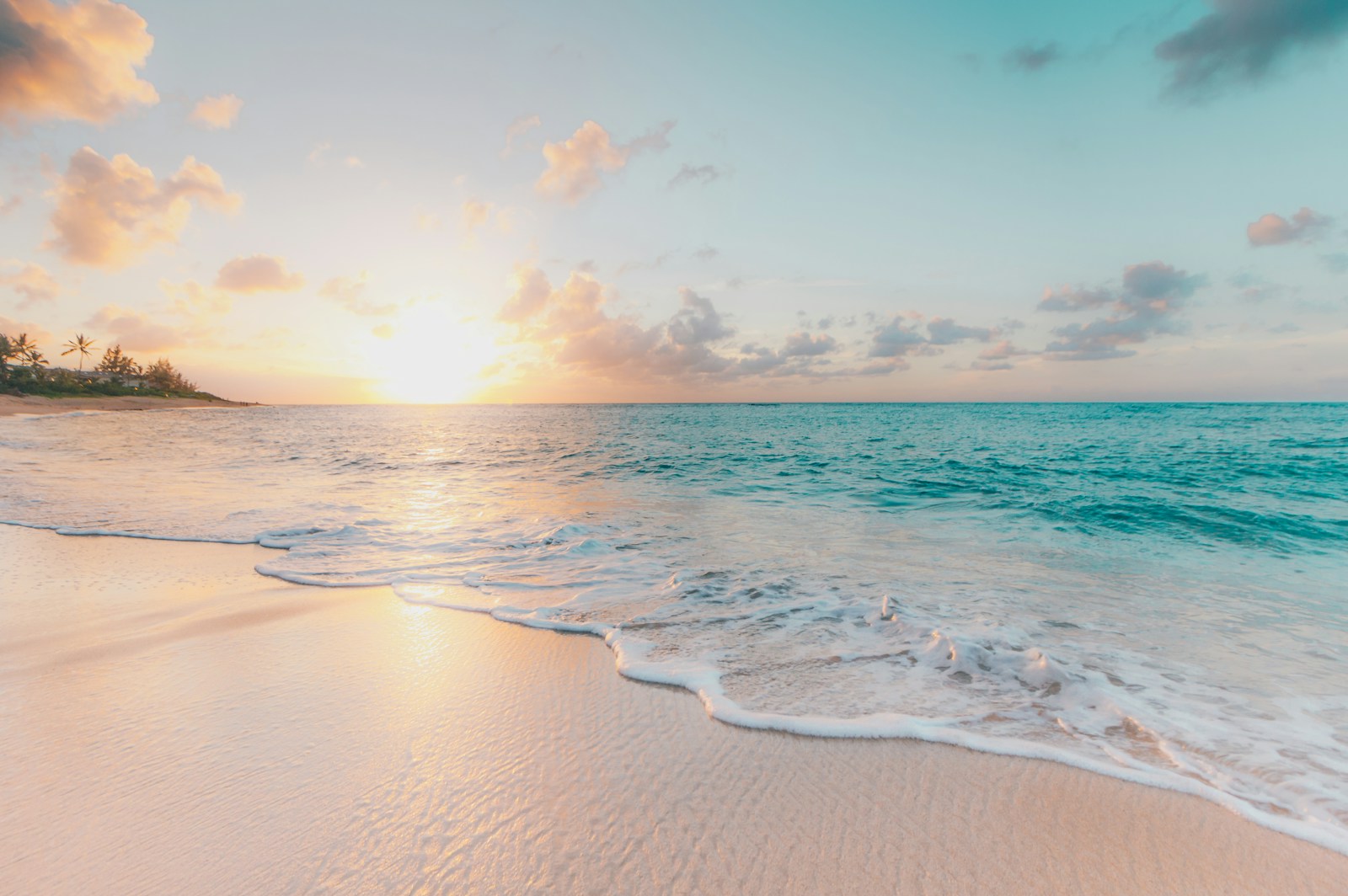
Upload PHOTO_HERO
Radhanagar Beach · Havelock · Andaman aerial
🏅 Ministry of Tourism Recognised · Govt. of India
📅 Est. 1991 — 35 years of island expertise
🌍 All languages — EN / FR / DE / AR / JP / ES
🤿 PADI-certified partner dive centres
Why the Andaman Islands Are Unlike Anywhere Else on Earth
The Andaman and Nicobar Islands stretch across 800 kilometres of the Bay of Bengal — closer geographically to Thailand than to mainland India, and it shows. The coral reefs here are part of the Indo-Pacific triangle, the most biodiverse marine environment on the planet. More species of fish have been recorded in these waters than in the entire Caribbean Sea. The forest covering the islands is ancient Indo-Malayan rainforest, identical in character to Sumatra and Borneo, filled with endemic species found nowhere else on Earth.
What separates the Andamans from Maldives or the Seychelles is scale and authenticity. These are not resorts built on a sandbar — they are proper islands, some large enough to contain mountain ranges, rivers, and indigenous peoples who have had no contact with the outside world for 60,000 years. The Jarawa tribe of South Andaman and the Sentinelese of North Sentinel Island are among the last uncontacted peoples on the planet. Their existence, silent and sovereign just beyond the jungle edge, gives these islands a quality of mystery that no manicured resort archipelago can replicate.
For luxury travellers, the Andamans offer a combination increasingly rare in the modern world: genuine wildness at five-star comfort level. Taj Exotica on Havelock, private beaches accessible only by chartered speedboat, bioluminescent kayaking at midnight, and a coral garden at Elephant Beach that turns the water 14 different shades of blue — all within a 2.5-hour flight from Delhi. We have been arranging Andaman luxury packages since these islands first opened to civilian tourism in 1994.
What Makes This Island World Unforgettable
Beyond the postcard images — these are the moments that rearrange your understanding of beauty.
01
Radhanagar Beach — Asia’s Finest
Havelock · Beach No. 7 · Time Magazine Best Beach
1.4 km of silica-white sand, old-growth rainforest behind, and water that transitions through six shades of blue before hitting deep cobalt. No sun-beds. No stalls. At sunset, the wet sand turns copper and the sea turns violet simultaneously — a combination of light and mineral that exists nowhere else.
02
Bioluminescent Night Kayaking
October–March · Private Bay · After Dark
Paddle through water that glows cold blue with every stroke. Dinoflagellates — 20-micron marine organisms — emit light when disturbed. Your paddle leaves trails of cold fire. Fish become blue comets beneath you. The experience is strongest on moonless nights during neap tides — we coordinate your session precisely.
03
Elephant Beach Coral Gardens
Snorkel + Scuba · 600+ Fish Species · 30m Clarity
Reached by a 15-minute speedboat from Havelock, Elephant Beach hosts one of India’s finest living reef systems — table corals, brain corals, and staghorns in water so clear you can read the date on a coin dropped at 8 metres. Resident sea turtles and reef sharks are a daily sighting. Beginners dive here; experts come for Barracuda City at 25m.
04
Cellular Jail — India’s Kala Pani
Port Blair · 1906 · National Memorial
Seven wings radiating from a central tower, each cell designed so no prisoner could see another. The jail that held India’s greatest freedom fighters — Savarkar spent 10 years here. The nightly sound-and-light show, narrated in multiple languages, recounts the independence movement with a directness and emotional power that few historic sites in the world match.
05
Neil Island — Solitude Perfected
35 km from Port Blair · The Quiet Alternative
Smaller and quieter than Havelock, Neil Island offers three completely different beach personalities — Laxmanpur (sunset sandbar), Bharatpur (snorkel reef), and Sitapur (dawn cliffs above the sea). The Howrah Bridge natural rock arch at Bharatpur is a geological formation unlike anything else in India. Neil rewards slow travellers who want the ocean without the audience.
06
Ross Island — Where Empire Ended
15 min from Port Blair · Jungle-Swallowed Ruins
Once called the “Paris of the East” by the British — complete with ballroom, church, swimming pool, and a bakery supplying all of colonial Asia. Now the jungle has taken it back: fig tree roots wrap the Commissioner’s Residence, deer walk through the officers’ mess. Ross Island is one of the most haunting places in India — the exact point where empire ended and nature resumed.

Upload PHOTO_RADHANAGAR
Radhanagar Beach · Havelock Island · Andaman
Havelock — Where the Reef Meets the Shore
Radhanagar · Elephant Beach · Kalapathar · Neil’s Cove
Havelock Island — officially Swaraj Dweep since 2018 — is the Andaman Islands’ crown jewel, and it knows it. The island is large enough to get lost in: 112 sq km of dense dipterocarp rainforest, fragmented by rice paddies and banana groves that signal Bengali settler communities from the 1950s. The forest sounds at night are extraordinary — nightjars, cicadas, and the occasional distant call of the Andaman wild pig form a sound environment unlike any other island in Asia.
Radhanagar Beach’s secret is its orientation. It faces west-northwest, meaning you get the full Arabian sunset effect — the sun sinking directly into the sea horizon without any obstruction. The beach also benefits from a gentle southerly current that keeps the sand perpetually clean; no seaweed, no debris. The water clarity here — measured at 28 metres visibility in peak season — is a function of the island’s position at the meeting point of the Bay of Bengal and the Andaman Sea, where warm and cool currents converge to create exceptional water quality.
Kalapathar Beach — named for the black rocks (kala patthar) scattered along its shore — is Havelock’s morning beach. Face east as the sun rises over the Bay of Bengal, the black volcanic rocks creating a foreground against water that turns from midnight blue to electric turquoise in the space of 20 minutes. There are no other people here before 8 AM. This is the Andamans before they were discovered.
The beach only locals know: A 20-minute walk through forest from the north end of Radhanagar leads to Neil’s Cove — a private horseshoe bay accessible only on foot at low tide. No signage, no facilities, no other tourists. The snorkelling at the eastern headland is among the finest shallow-water reef in the Andamans. Ask your guide specifically for this route; most drivers don’t mention it.
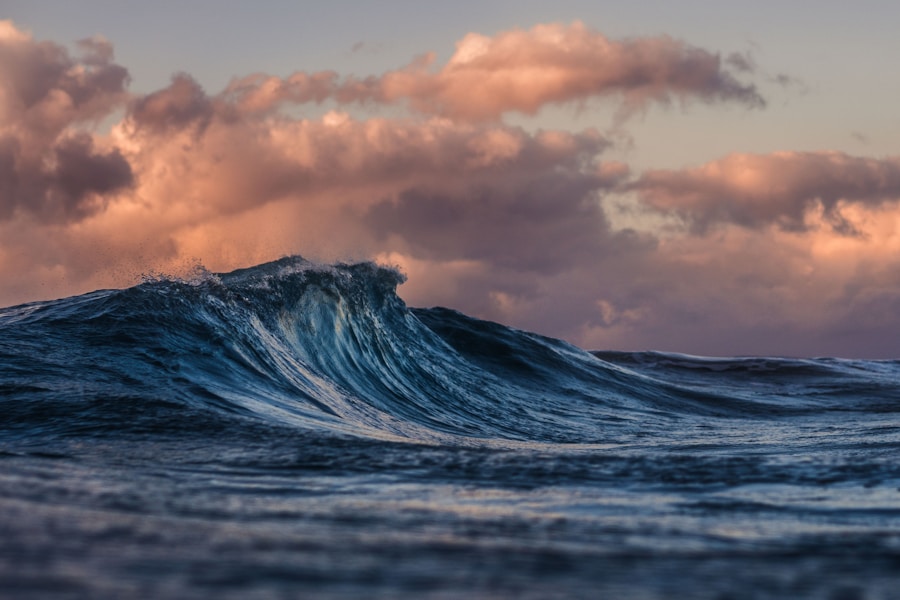
Upload PHOTO_NEIL
Neil Island · Bharatpur Natural Rock Arch
Neil Island — The Quiet Side of Paradise
Laxmanpur · Bharatpur · Sitapur · Howrah Bridge Rock Arch
Neil Island — renamed Shaheed Dweep in 2018 — is smaller (18 sq km), flatter, and quieter than Havelock. Where Havelock has adventure, Neil has contemplation. The island supports a community of Bengali and Ranchi settlers who grow vegetables — Neil is sometimes called the “vegetable bowl” of the Andamans, supplying Port Blair’s markets with tomatoes, pumpkins, and brinjals grown in red laterite soil fringed with coconut palms.
The island’s three beaches are dramatically different from each other. Laxmanpur Beach, facing west, offers the finest sandbar sunset in the Andamans — a 400m tongue of sand extending into the shallows at low tide, where you can stand knee-deep in water with the sun setting directly ahead. Bharatpur Beach has the densest shallow-water coral in the islands — snorkel over it and lose count of parrotfish, clownfish, and angelfish moving through staghorn formations within a metre of the surface. Sitapur Beach, facing east, is a coral bay enclosed by volcanic cliffs — arrive at 6 AM to see dawn light hitting the sea in absolute silence.
Beyond the main Laxmanpur beach: A 10-minute walk northeast past the lighthouse ruins leads to a secondary bay (locally called Laxmanpur II) that is entirely undiscovered by the tourist circuit. The reef flat here emerges at low tide to reveal a tidal pool ecosystem — sea urchins, starfish, small octopus, and juvenile reef fish in water 30cm deep. Bring a mask and simply lie face-down in the shallows. Nothing separates you from the reef except a millimetre of water.

Upload PHOTO_ROSS
Ross Island jungle ruins · Port Blair
Port Blair & Ross Island — History Reclaimed by Wilderness
Cellular Jail · Ross Island Ruins · Corbyn’s Cove · North Bay · Chidiyatapu
Port Blair is where every Andaman journey begins and ends — and it deserves more than a transit halt. The city sits in a natural harbour formed by two arms of land that shelter the bay from monsoon swell, which is why the British chose it in 1858 as the site of their colonial penal settlement. The harbour view from Chatham Island at dawn — fishing boats making out through flat water, the distant islands appearing in silhouette — is one of the finest harbour vistas in Asia.
The Cellular Jail demands the full experience. Book the evening sound-and-light show (two shows nightly, different languages) — it runs for 45 minutes and uses the jail’s actual architecture as a stage. The voices of the imprisoned freedom fighters, the solitary confinement recreation, the gallows wing — all illuminated, narrated, and impossible to leave unchanged. During the day, the Cellular Jail Museum fills in the extraordinary detail: letters smuggled out in code, hunger strikes that lasted 40 days, and the remarkable solidarity among prisoners who technically couldn’t see each other.
Chidiyatapu — “Sunset Point” at the southernmost tip of South Andaman — is Port Blair’s secret. The name means “bird island” in the Andamanese language, and the wetland behind the beach is one of the finest birdwatching sites in the archipelago. But the real draw is the sunset: from the cliff above the beach, you watch the sun drop between two islands on the horizon, the sea turning orange, then rose, then deep purple in quick succession. No tourist facilities exist here — bring your own provisions.
The clearest water in the Andamans: The Mahatma Gandhi Marine National Park at Wandoor (29 km from Port Blair) contains Jolly Buoy Island — a 1.5 sq km uninhabited island surrounded by a Marine National Park that limits daily visitors to 200. The coral here has never been touched by anchor or fin drag because the park requires snorkellers to float passively in life jackets. The result is a reef in near-pristine condition, with visibility exceeding 35 metres and coral coverage approaching 80%. Book Jolly Buoy permits through us in advance — they sell out 2–3 weeks ahead in peak season.
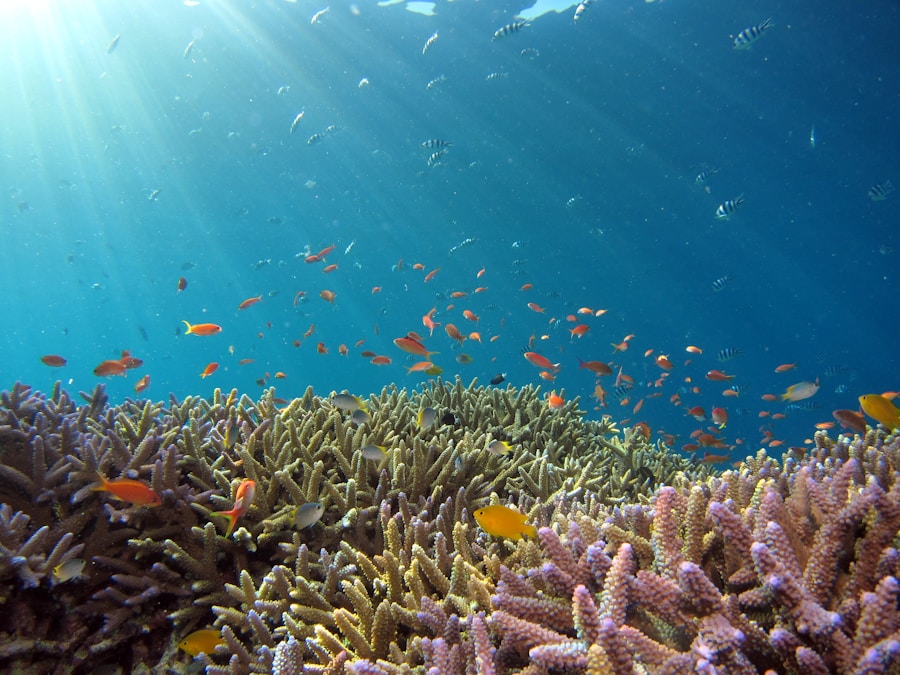
Upload PHOTO_DIVING
Andaman coral reef · scuba diving
Diving the Andamans — India’s Coral Triangle
Nemo Reef · Aquarium · Barracuda City · Lighthouse Rock · Dixon’s Pinnacle
The Andaman Islands contain India’s only true coral reef system. Unlike the bleached, degraded reefs of the Gulf of Mannar or Lakshadweep, the Andaman reefs have largely escaped mass bleaching events because of the deep cold-water upwellings from the Andaman Trench (4,180m deep, running along the eastern side of the archipelago). The water is slightly cooler here than the surrounding ocean — cold enough to suppress the thermal stress that kills coral, warm enough for humans in a 3mm wetsuit.
Nemo Reef (Havelock) is the first dive for beginners — wall coral and table coral at 6-12m, resident clownfish in anemones, a cleaning station where parrotfish queue to have parasites removed by cleaner wrasse. It sounds transactional; underwater, it looks like choreography. Aquarium (Port Blair, North Bay) is the most photographed site: a shallow lagoon so dense with fish that your first entry makes you feel like you’ve fallen into a fish tank. Lighthouse Rock (Port Blair) is for advanced divers — a submerged pinnacle dropping to 28m, hosting grey reef sharks, eagle rays, and schools of trevally so large they temporarily block the ambient light.
For non-divers, sea walking at North Bay (Port Blair) uses a pressurised helmet to walk on the seabed at 5-7m without any training or swimming ability required. You walk through a living reef with fish swimming around you at eye level. Children from 10 years old can participate. It is, frankly, more astonishing than many experienced divers expect.
Diving an active volcano: Barren Island — 135 km northeast of Port Blair — is South Asia’s only active volcano, erupting continuously since 1991. A special permit allows a liveaboard dive boat to approach, and the dive sites around the island feature black lava formations colonised by dense soft corals, hammerhead sharks in the thermocline below 30m, and tuna schools that move through in walls. The combination of surface fire and underwater life is an experience that exists in perhaps five places in the world. Sanoli arranges the permit and the liveaboard; request this when you enquire.
The Deep History of These Islands
From the world’s oldest surviving human population to the end of the British Empire — these islands carry more history per square kilometre than almost anywhere on Earth.
Genetic studies published in Nature (2003) confirmed that the Great Andamanese, Onge, Jarawa, and Sentinelese peoples are direct descendants of the first human migration out of Africa along the southern coastal route — the oldest population outside Africa to survive genetically intact. They arrived before the invention of agriculture, before ceramics, before the wheel. The Sentinelese of North Sentinel Island have had zero contact with the outside world and remain armed and hostile to any approach. Their sovereignty is legally protected by the Indian government, which has prohibited all contact since 1996. They are the only people on Earth living precisely as their ancestors lived 60,000 years ago.
The East India Company’s first attempt at settlement (1789) was abandoned within three years due to tropical disease — half the garrison died in the first monsoon. A second attempt in 1858, following the Indian uprising of 1857, established Port Blair as a penal colony for independence fighters. The decision to locate the jail here — 1,300 km from the mainland, surrounded by shark-infested water — was deliberate. The term “kala pani” (black water) carried a double meaning: the sea crossing and the Hindu belief that crossing the ocean broke the sacred thread of caste, making the prisoner ritually dead to their family.
Construction began in 1896 and completed in 1906: 698 cells arranged in seven wings radiating from a central observation tower, with each cell positioned so no prisoner could see another — “cellular” refers to the isolation, not the building material. Among those imprisoned were Bal Gangadhar Tilak, Batukeshwar Dutt (Gandhi’s associate), and Vinayak Savarkar, who spent 10 years in solitary confinement, using coal to write his history of the 1857 uprising on the cell walls when his pen was confiscated. The British considered this their most effective counter-revolutionary tool. The prisoners called it simply: kalapani.
Japan occupied the Andamans from March 1942 to August 1945 — the only Indian territory held by Japan during WWII. The Japanese ended the British penal colony but created their own reign of terror: the Andamanese population was subjected to forced labour, and several hundred civilians were executed on suspicion of espionage. Subhash Chandra Bose raised the Indian tricolour over the Cellular Jail on December 30, 1943 — the first Indian territory to fly the free flag. When the Japanese withdrew in 1945, they left Ross Island in ruins; the 1941 earthquake had already broken its water mains, and the jungle moved in immediately. No one ever repaired it.
Until 1994, the Andaman Islands were almost entirely closed to civilians — the strategic importance of the archipelago (controlling the Bay of Bengal and Malacca Strait access) meant military restrictions dominated. The first tourist permits were issued in 1994. Within a decade, Havelock Island’s Radhanagar Beach had been voted Asia’s Best Beach by Time magazine (2004), and a new chapter began. The Indian Navy still controls 70% of the archipelago — the reason the majority of the 572 islands remain pristine, uninhabited, and inaccessible: they exist in a military exclusion zone that effectively functions as the world’s largest accidental marine reserve.
The Food That Tastes Like the Ocean
Andaman cuisine is a meeting of Bengali, Tamil, Ranchi, and indigenous traditions — united by one element: the freshest seafood anywhere in India, caught the same morning it reaches your plate.
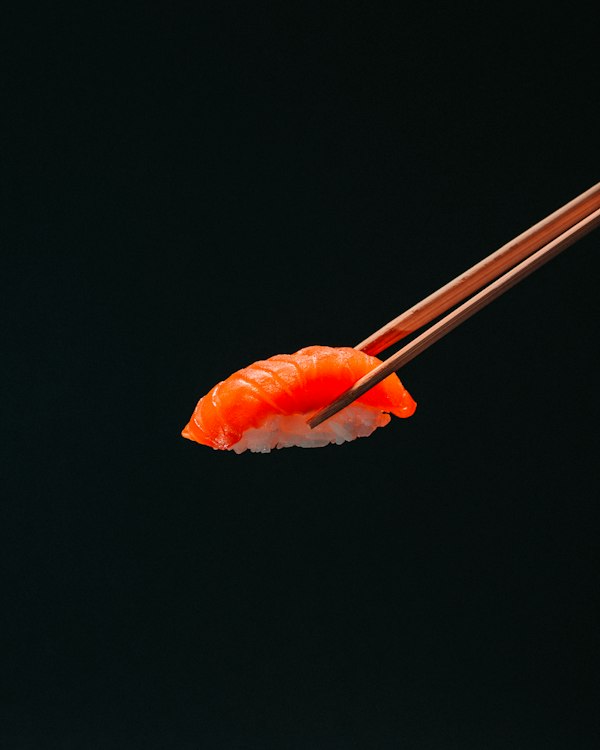
🦞 The Island’s Signature
📍 Where: Anju Coco Resort beach restaurant · Havelock | Mandalay Restaurant · Port Blair
The spiny lobster (Panulirus ornatus) pulled from Andaman reefs is among the finest crustacean in the world — large, sweet, and almost nut-like in texture. Grilled simply with garlic butter and lime, it needs no adornment. Order one per person. The price (₹800–2,000 depending on size) feels extravagant until you taste it. At Anju Coco on Havelock, they bring the live lobster to your table so you choose the exact one. Market fishermen sell them on the Port Blair jetty each morning at 6 AM.
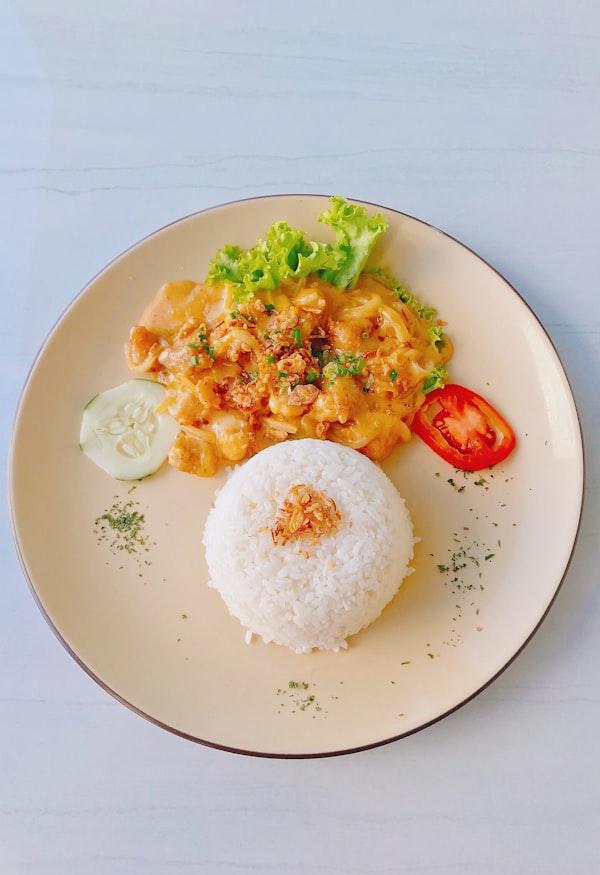
🐟 Tamil-Andamanese Fusion
📍 Where: Lighthouse Residency restaurant · Port Blair | Full Moon Café · Havelock
Barracuda — the aggressive apex predator of Andaman reefs — turns out to be exceptional eating when young: firm, flaky, and almost sweet. Cooked in the Tamil settler tradition with fresh coconut milk, red chilli, curry leaves, and tamarind, the curry has a complexity that belies its 4-ingredient base. The Andaman version uses kokum (a local souring fruit related to mangosteen) instead of tamarind — a slight difference that changes the dish’s character completely.
🦀 Bengali-Andaman Style
📍 Where: Annapurna Cafeteria · Port Blair | Barefoot Scuba Restaurant · Havelock
The mud crabs (Scylla serrata) from Andaman’s mangrove systems are the largest in India — a single claw can weigh 400g. Bengali settlers cook them in a spiced tomato-onion masala with panch phoron (five-spice mix) — a combination that shouldn’t work but produces a dish of extraordinary depth. Eating a whole mud crab with your hands, cracking the claws at a waterfront table, as the sun sets over Port Blair harbour — this is the Andamans at their most alive.
🦑 The Sundowner Snack
📍 Where: Red Snapper · Havelock | Emerald Gecko · Neil Island
Every beach shack in the Andamans serves calamari rings, and every version is different. The squid here is caught within hours; the rings have a tenderness that frozen squid never achieves. The best preparation is the simplest: tossed in rice flour with turmeric and black pepper, fried for 90 seconds in coconut oil. Eaten with cold Kingfisher and a view of the ocean at 5 PM — this is the Andaman experience distilled to its essential elements.
🍚 The Working Lunch
📍 Where: New Lighthouse Restaurant · Port Blair | Café del Mar · Neil Island
The best ₹150 meal in the Andamans: a stainless steel thali with rice, dal, two fish preparations (one fried, one curried), a vegetable, pickle, and papad. The fish changes daily — whatever came in that morning. The simplicity is deceptive; the dal is complex from long cooking with island spices, the fish curry uses a base that Andamanese cooks don’t share with outsiders. This is the meal the fishermen eat. It is also frequently the best meal of a trip.
🥥 The Island Dessert
📍 Where: Every beach shack · Andaman Islands
Fresh tender coconut chilled in a bucket of ice, cracked open tableside, the water drunk through a straw, and the soft coconut flesh scooped and eaten with a spoon fashioned from the shell — this is the Andaman Islands’ answer to dessert. At ₹30–50, it is the single best value food experience in the archipelago. The coconuts from these islands have a sweetness different from mainland varieties — a subtle caramel note that Andaman farmers attribute to the salt in the groundwater. We have no reason to doubt them.
Curated Island Accommodations
From overwater-style villas to boutique jungle retreats — these are the properties Sanoli India Tours has personally vetted and stays with year after year.
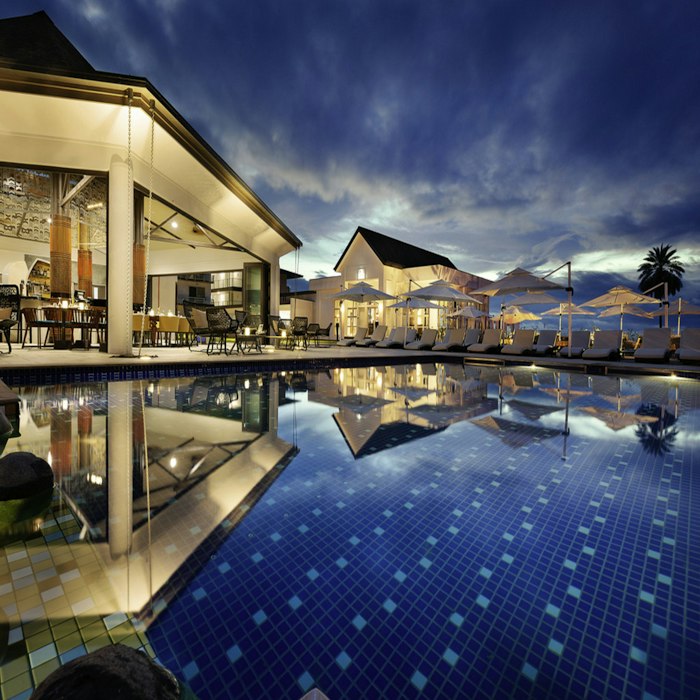
Taj Exotica Resort & Spa
📍 Beach No. 5, Havelock Island
The Andamans’ finest property — private beachfront villas with outdoor showers, a spa using local Andaman forest ingredients, and the only overwater-adjacent infinity pool in the archipelago. Their beachside restaurant sources directly from the morning catch. The resort’s private beach is kept exclusive to guests. Rooms from ₹18,000/night. Book 6+ weeks ahead in peak season.
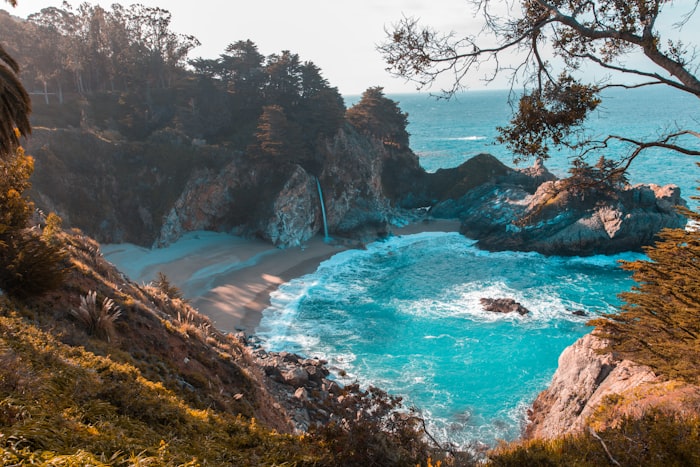
Symphony Palms Beach Resort
📍 Beach No. 5, Havelock Island
Sea-facing premium cottages built in local timber, set directly on the beach with private verandahs where breakfast is served each morning. Smaller and more personal than Taj Exotica, with a warmth in service that larger resorts rarely achieve. The dive centre attached to the property uses PADI-certified instructors who know the local sites intimately. Rooms from ₹8,000/night.
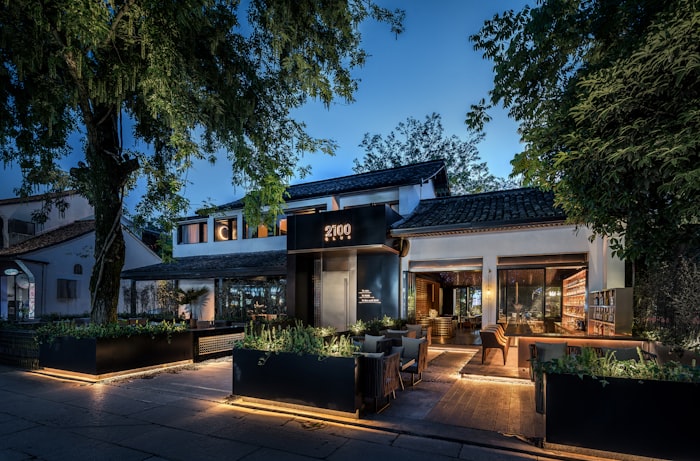
Fortune Resort Bay Island
📍 Marine Hill, Port Blair
The finest harbour-view property in Port Blair — rooms facing east watch the sunrise over Aberdeen Bay as fishing boats make their morning runs. A practical first/last-night base combining genuine comfort with proximity to the ferry terminal (12 min), Cellular Jail (8 min), and Aberdeen Bazaar (5 min). Their rooftop Nico bar has the best rum selection in the islands. Rooms from ₹5,500/night.
Tango Beach Resort
📍 Bharatpur Beach, Neil Island
Neil Island’s finest property — 20 rooms in whitewashed cottages surrounded by a working fruit garden. The owner (a marine biologist) offers private guided reef walks at Bharatpur Beach included in the room rate. Wake to the sound of waves 30m from your window. No pool, no gym, no nightlife — exactly right. Tango Beach is for guests who want the Andamans without the audience. Rooms from ₹4,500/night.
Long Island Eco Retreat
📍 Long Island · Chartered boat access only
The Andamans’ most exclusive stay — four safari tents on a private beach of Long Island, accessible only by a 45-minute chartered speedboat from Port Blair. Zero other guests, zero other resorts, zero light pollution at night. The bioluminescence here (protected bay, no boat traffic) is the strongest in the archipelago. Solar-powered, rainwater-harvested, with a private cook. Maximum 8 guests per booking. Ask Sanoli India Tours specifically for this — it is not listed on any platform.
Barefoot Liveaboard — MV Andaman Explorer
📍 Multiple dive sites · 5-night circuit
The finest way to see the Andamans: a 5-night liveaboard dive safari covering sites inaccessible from land — Barren Island volcano, North Passage reefs, Invisible Bank (where hammerhead aggregations form October to December). Cabins for 12 guests, two dive guides, a marine biologist guide, and a cook. Minimum 4 certified dives per day. For divers: this is the single greatest experience the Andamans offer. Packages from ₹65,000 per person all-inclusive.
Stories, Legends & Secrets of the Islands
Suggested 7-Night Itinerary
Every itinerary is shaped around your interests — diving, culture, complete relaxation, or all three. This is a guide, not a constraint.
Morning flight from Delhi (2h 15m) arrives Port Blair (IXZ) by 10 AM. Private transfer to hotel (Fortune Resort Bay Island recommended). Afternoon: ferry to Ross Island (15 min, ₹150 return) — 2 hours among the jungle-swallowed ruins. Deer, fig trees through the ballroom ceiling, Japanese surrender documents in the archive room. Return to Port Blair for sunset from Corbyn’s Cove Beach. Evening: Cellular Jail sound-and-light show (book through Sanoli — seats limited).
Morning: Full Cellular Jail visit (open 9 AM) — allow 2 hours for the museum, solitary wing, and gallows. Chatham Island Saw Mill (oldest working sawmill in Asia, 1836) adjacent. Lunch at Lighthouse Residency (best seafood in Port Blair). Afternoon: Chidiyatapu (45 min drive, mangrove birdwatching, sunset from cliff). Evening: Mandalay Restaurant Port Blair — Andaman lobster dinner. Night: transfer to ferry terminal for early morning Havelock crossing.
Morning: Radhanagar Beach (Beach No. 7) — arrive by 8 AM for empty beach. Swim in water that is genuinely 27 different colours. Stay for the full morning. Lunch at a local shack (ask guide for the unmarked place 200m east of the main beach — it serves the fish thali the Havelock fishermen eat). Afternoon: PADI intro dive or snorkel at Nemo Reef. Evening: sunset at Radhanagar (4:30 PM arrival essential). Dinner at Anju Coco Resort — grilled lobster.
Speedboat to Elephant Beach (15 min). Full morning: two-tank dive at Nemo Reef + Barracuda City for certified divers; snorkel + sea walking at Elephant Beach for non-divers. The reef at Elephant Beach is accessible in water 1–8m deep — put your face in and lose count of species. Afternoon: Kalapathar Beach (20 min drive — black rock formations, east-facing, completely different from Radhanagar). Pack a picnic — no food available. Evening: Neil’s Cove secret walk (guide required).
Morning: Havelock forest walk with naturalist guide (3 hrs — Andaman serpent eagle, flying fox, stick insects as long as your forearm). Afternoon free — resort, beach, or massage (Taj Exotica spa uses locally harvested sea-salt and rainforest oils). Evening 6 PM: dinner early. 8:30 PM: bioluminescent kayaking session (1.5 hrs — glass kayak, no moon, private bay). This is the night that defines the entire trip. Sleep late. You will need it.
Ferry: Havelock to Neil (50 min). Bharatpur Beach (Howrah Bridge arch, snorkel reef, tidal pools at low tide). Lunch at Café del Mar Neil — the best fried calamari in the Andamans. Laxmanpur I & II (sunset sandbar and the secret tidal pool bay beyond the lighthouse). Sitapur Beach dawn is optional — if you have an early riser in your group, 5:45 AM at Sitapur Beach, east-facing cliffs above the sea, is one of the finest sunrise experiences in the archipelago. Night ferry back to Port Blair (or overnight at Tango Beach Resort — highly recommended).
Morning: Aberdeen Bazaar — the Port Blair market where Andaman’s cultural mix is most vivid: Bengali pickle vendors, Tamil flower sellers, Ranchi craftsmen, and stalls selling conch shells, black coral jewellery, and dried sea creatures. Andaman Anthropological Museum (free entry; documentation of the indigenous peoples — respectful and comprehensive). Samudrika Naval Maritime Museum (scale models of the entire archipelago — useful context for everything you’ve just experienced). Private transfer to IXZ Airport for afternoon Delhi flight. You land in Delhi the same evening.
What’s Included in Your Package
One price. No surprises. Every logistic managed — from Delhi departure to Andaman arrival and everything in between.
Voices from 35 Years of Island Journeys
“I’ve dived in 22 countries. The Andaman dive sites — Lighthouse Rock especially — are genuinely world-class. But it was the bioluminescent kayaking that undid me completely. Paddling through water that lights up around every stroke, alone in a bay with no light on the horizon — I understand why people become addicted to this archipelago. Sanoli arranged everything seamlessly; not one logistic went wrong in 8 days.”
James Whitfield
Marine Photographer · Melbourne, Australia · 8 nights, dive focus
“Nous sommes venus pour notre voyage de noces — sans plongée, sans aventure, juste la plage et la mer. Radhanagar Beach a dépassé tout ce que nous avions imaginé. La couleur de l’eau est inexplicable en photographie. Taj Exotica était parfait. La soirée bioluminescente était magique au-delà des mots. Sanoli a tout pensé avant nous — chaque transition était fluide. Nous revenons en novembre.”
Sophie & Éric Fontaine
Honeymooners · Paris, France · 7 nights
“The Cellular Jail moved me to tears — and I am not a person who cries easily. The sound-and-light show, the actual cells, reading Savarkar’s name carved into the wall — history becomes very real when you stand inside it. The rest of the trip — Ross Island’s extraordinary jungle-swallowed ruins, Neil Island’s silence, the reef at Elephant Beach — was one astonishment after another. This is a remarkable group of islands and Sanoli knows them completely.”
Dr. Priyanka Sharma-Holmes
Historian · London, United Kingdom · 8 nights · history focus
Everything You Need to Know
Other Packages You Might Love
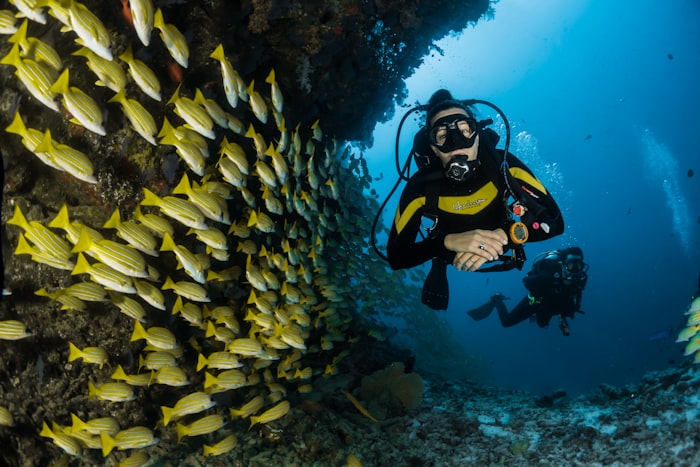
Lakshadweep Atoll Escape
India’s coral atolls — genuine lagoons with water so shallow you can see the fish from the aircraft. Fewer visitors than the Andamans; even more pristine. Limited permits make this the more exclusive Indian island experience.
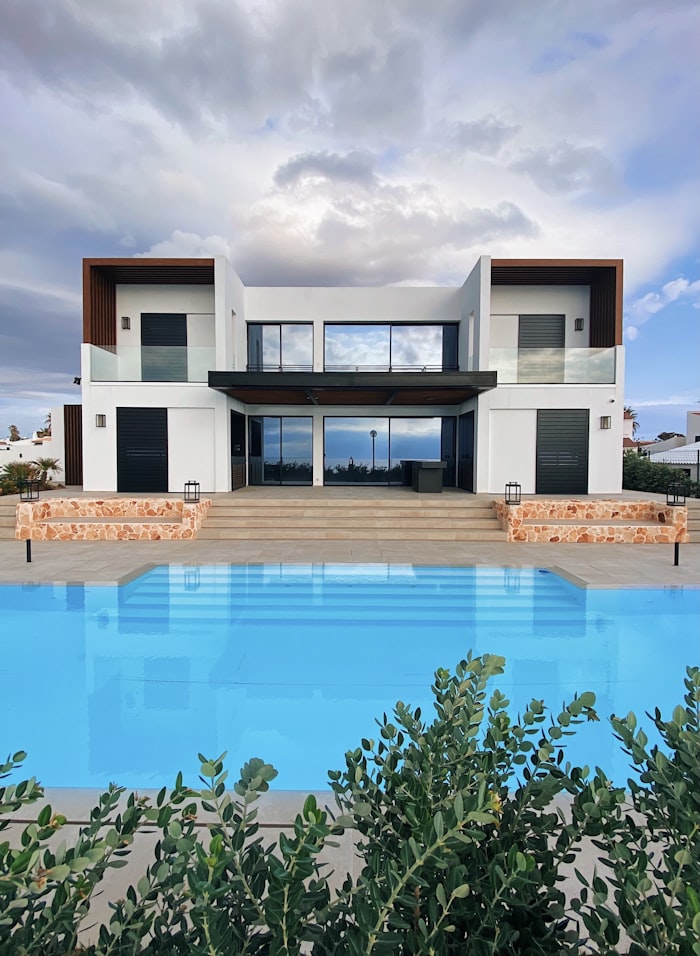
Kerala Ayurveda Rejuvenation
From Andaman ocean energy to Kerala coastal healing — Panchakarma at Kovalam, Alleppey backwaters, and Kathakali dance. The natural pairing for guests who want the water AND the wellness.
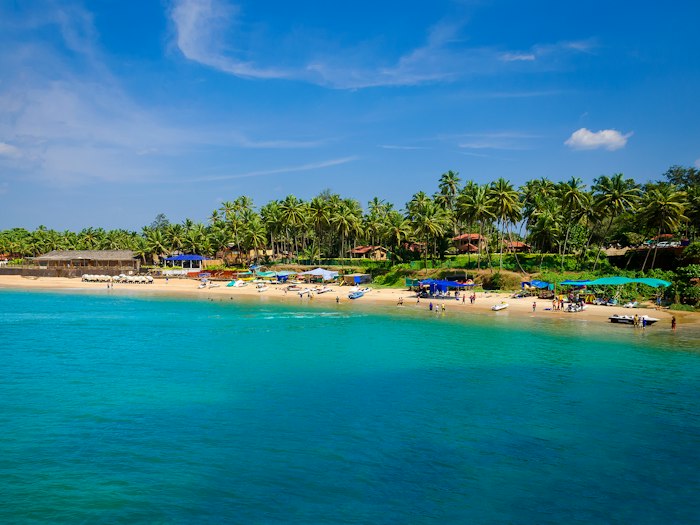
Goa Heritage & Coastal Luxury
Portuguese-era spice estates, private villa stays, and the finest sunset stretch of coast in mainland India. A sophisticated alternative for guests who want coast, culture, and cuisine without the ferry crossings.
Begin Your Island Escape
Tell us your travel dates, your interests — diving, history, pure relaxation, or the bioluminescent night — and we’ll design your complete Andaman journey. The right islands, the right properties, every ferry pre-booked. Full itinerary sent within 4 hours. Free. No obligation.
Ministry of Tourism, Govt. of India · GSTIN 07AOJPS1151F4ZY · Est. 1991 · New Delhi · 8, Suvidha Market, Netaji Nagar · +91 9717278522
Radhanagar · Bioluminescence · Coral Reefs · Ross Island · Ministry of Tourism Recognised · Est. 1991
/* ═══════════════════════════════════════════ BIOLUMINESCENT CANVAS — animated ocean floor ═══════════════════════════════════════════ */ (function(){ var canvas = document.getElementById('andCanvas'); if(!canvas) return; var ctx = canvas.getContext('2d'); var W, H, particles = [], frame = 0;
function resize(){ W = canvas.width = window.innerWidth; H = canvas.height = window.innerHeight; } resize(); window.addEventListener('resize', resize);
/* Create particles */ for(var i=0; i .5 ? '0,245,224' : '0,197,212' }); }
function draw(){ ctx.clearRect(0,0,W,H); frame++; for(var i=0; i<particles.length; i++){ var p = particles[i]; p.pulse += p.pulseSpeed; var a = p.alpha * (0.5 + 0.5*Math.sin(p.pulse)); ctx.beginPath(); ctx.arc(p.x % W, p.y % H, p.r, 0, Math.PI*2); ctx.fillStyle = 'rgba('+p.color+','+a+')'; ctx.fill(); /* Soft glow */ ctx.beginPath(); ctx.arc(p.x % W, p.y % H, p.r*3, 0, Math.PI*2); ctx.fillStyle = 'rgba('+p.color+','+(a*0.15)+')'; ctx.fill(); p.y -= p.speed; p.x += p.drift; if(p.y < -10) p.y = H + 10; } requestAnimationFrame(draw); } draw(); })();/* ═══════════════════════════════ LIVE BUBBLES + FISH + SPARKLES ═══════════════════════════════ */ (function(){ var live = document.getElementById('andLive'); if(!live) return;/* Bubbles */ for(var i=0; i<22; i++){ var b = document.createElement('div'); b.className = 'and-bubble'; var sz = 4 + Math.random()*16; b.style.cssText = [ 'left:'+(Math.random()*100)+'%', 'width:'+sz+'px','height:'+sz+'px', 'animation-duration:'+(8+Math.random()*14)+'s', 'animation-delay:'+(Math.random()*10)+'s', 'opacity:'+(0.3+Math.random()*0.4) ].join(';'); live.appendChild(b); }/* Fish */ var fish = ['🐠','🐟','🐡','🦈','🐬','🐢']; for(var j=0; j<10; j++){ var f = document.createElement('div'); f.className = 'and-fish'; f.textContent = fish[Math.floor(Math.random()*fish.length)]; f.style.cssText = [ 'top:'+(10+Math.random()*80)+'%', 'font-size:'+(14+Math.random()*10)+'px', 'animation-duration:'+(20+Math.random()*30)+'s', 'animation-delay:'+(Math.random()*20)+'s' ].join(';'); live.appendChild(f); }/* Sparkles */ for(var k=0; k<18; k++){ var s = document.createElement('div'); s.className = 'and-sparkle'; s.textContent = ['✦','◈','·','✧','◦'][Math.floor(Math.random()*5)]; s.style.cssText = [ 'left:'+(Math.random()*95)+'%', 'top:'+(Math.random()*95)+'%', 'animation-duration:'+(1.5+Math.random()*3)+'s', 'animation-delay:'+(Math.random()*4)+'s', 'font-size:'+(8+Math.random()*8)+'px' ].join(';'); live.appendChild(s); } })();/* ══ ACCORDION: ITINERARY ══ */ function andPhase(btn){ var phase = btn.closest('.and-phase'); var body = phase.querySelector('.and-phase-body'); var open = btn.classList.contains('open'); document.querySelectorAll('.and-phase-btn.open').forEach(function(b){ b.classList.remove('open');b.setAttribute('aria-expanded','false'); b.closest('.and-phase').querySelector('.and-phase-body').classList.remove('open'); }); if(!open){btn.classList.add('open');btn.setAttribute('aria-expanded','true');body.classList.add('open');} }/* ══ ACCORDION: FAQ ══ */ function andFaq(btn){ var item = btn.closest('.and-faq-item'); var ans = item.querySelector('.and-faq-ans'); var open = btn.classList.contains('open'); document.querySelectorAll('.and-faq-btn.open').forEach(function(b){ b.classList.remove('open'); b.closest('.and-faq-item').querySelector('.and-faq-ans').classList.remove('open'); }); if(!open){btn.classList.add('open');ans.classList.add('open');} }/* ══ SCROLL REVEAL ══ */ var andObs = new IntersectionObserver(function(en){ en.forEach(function(e){if(e.isIntersecting){e.target.classList.add('in');andObs.unobserve(e.target);}}); },{threshold:0.07}); document.querySelectorAll('.and-reveal').forEach(function(el){andObs.observe(el);});/* ══ HIGHLIGHT CARD 3D TILT ══ */ document.querySelectorAll('.and-hl-card').forEach(function(card){ card.addEventListener('mousemove',function(e){ var r = card.getBoundingClientRect(); var x = (e.clientX - r.left)/r.width - 0.5; var y = (e.clientY - r.top) /r.height - 0.5; card.style.transform = 'translateY(-10px) rotateX('+(-y*8)+'deg) rotateY('+(x*8)+'deg) scale(1.01)'; }); card.addEventListener('mouseleave',function(){ card.style.transform = ''; }); });